
Auroville
Sustainable Living, Auroville
Since 1968, Auroville has reforested a barren plateau, pioneered solar cooking for a thousand meals a day, and developed compressed earth architecture now taught across dozens of countries. A working model, not a showcase.
Auroville is frequently cited as one of the world's most significant experiments in sustainable living, and not without reason. What began as a practical necessity in the late 1960s, building a community on barren land with no infrastructure, became a working model that has influenced ecological, architectural and energy projects across India and internationally.
Reforesting a barren landscape
When Auroville was founded in 1968, the plateau north of Pondicherry had been stripped of most of its tree cover by centuries of fuel collection and grazing, leaving exposed red earth that washed away with each monsoon.
Beginning in the early 1970s, residents launched a sustained reforestation programme. By planting around two million trees and restoring native vegetation from more than 1,000 plant species, they rebuilt large areas of Tropical Dry Evergreen Forest, one of the rarest ecosystems in India.
The results extended beyond the trees. Richer soils, improved biodiversity and cooler local temperatures allowed wildlife to return: dozens of bird species, jackals, civet cats and porcupines now inhabit the Green Belt. Groundwater recharge has improved measurably, though regional urban growth continues to put pressure on local aquifers. The reforestation remains one of Auroville's defining achievements and is still actively maintained.
Organic farming
Several community farms produce organic fruits, vegetables, grains, dairy products and herbs for the township's cafés, community kitchens and residents. Farmers combine organic cultivation with biodynamic practices, composting, seed conservation and natural pest management, adapting their methods to Tamil Nadu's hot, seasonally dry climate.
Some farms welcome visitors for guided tours, workshops or short volunteer experiences.
Renewable energy and the Solar Kitchen
Rooftop solar panels, biogas systems, solar water heaters and small wind installations are distributed throughout the township. Auroville has been recognised as an early pioneer in decentralised renewable energy for semi-rural environments.
Its best-known installation is the Solar Kitchen, the township's main communal dining hall. Capable of serving up to a thousand meals per sitting, it is partly powered by a 15-metre parabolic solar concentrator that tracks the sun and generates steam for cooking. A hybrid backup keeps it running during cloudy weather, making it one of India's earliest large-scale demonstrations of solar thermal cooking.
Earth architecture
Many buildings in Auroville use Compressed Stabilised Earth Blocks (CSEB), made from the region's iron-rich laterite soil. These require far less energy to produce than fired bricks and provide good thermal comfort in the tropical climate. Their warm reddish colour has become an architectural signature of the township.
Research and training in earth construction is led by the Auroville Earth Institute, which has trained thousands of architects, engineers and builders from dozens of countries. The Visitors' Centre and the Solar Kitchen both demonstrate these techniques.
Water conservation
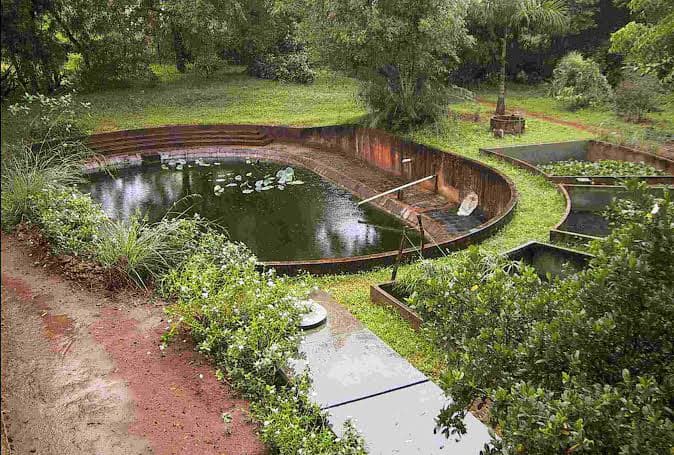
The region receives heavy monsoon rains followed by long dry seasons. Residents have built an extensive network of earthen bunds, check dams, recharge ponds and rainwater harvesting systems to capture rainfall, slow erosion and allow water to recharge underground aquifers.
Each monsoon, residents monitor whether the check dams are holding, whether the bunds are intact, whether groundwater levels are responding. Water is treated as a collective responsibility here in a way that is unusual anywhere in South India. The work is ongoing and unfinished, which is also true of Auroville itself.
Visiting
The Visitors' Centre provides information on ecological projects. Several farms, forests and research centres organise guided tours and workshops by prior arrangement. Whether walking the forest trails, examining earth-built structures or eating at the Solar Kitchen, the experience makes clear that sustainability here is not an attraction. It is part of everyday life.

The Pondy App
Take this guide with you
Offline maps, street-level history, restaurant picks, and hotel guides: everything on this site, in your pocket.