
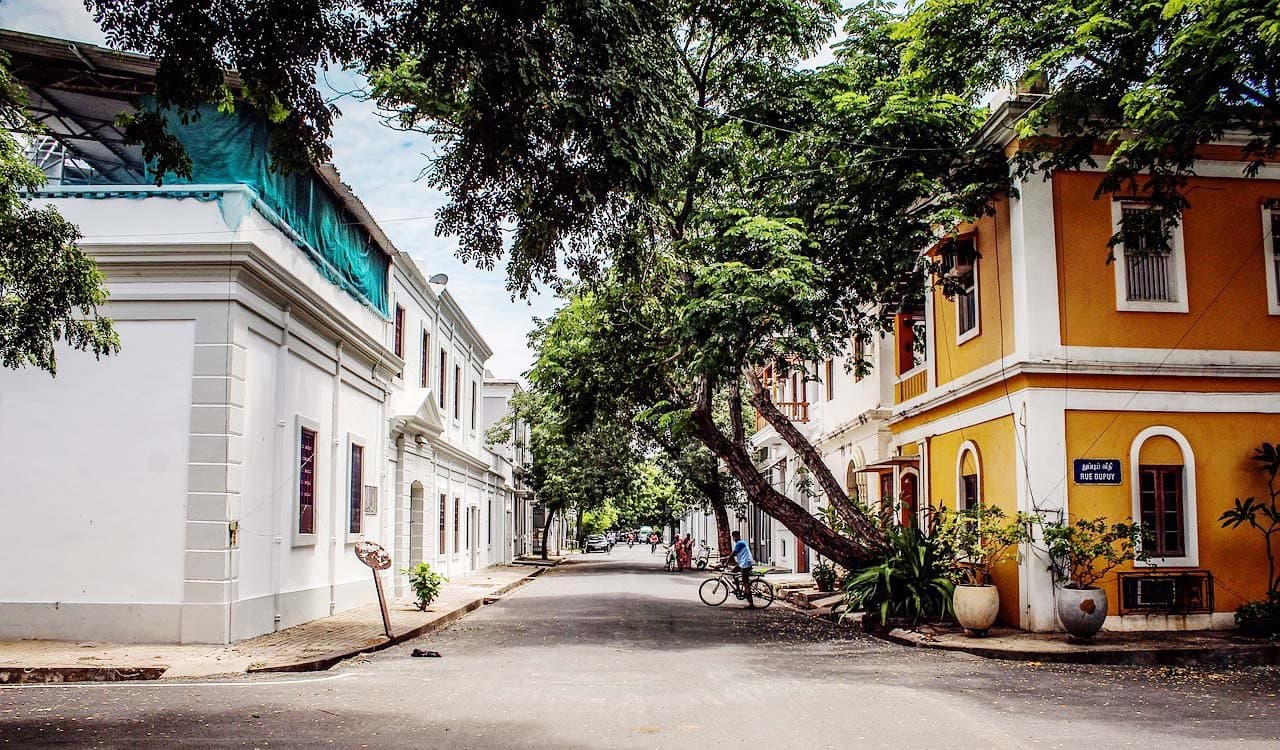
East–West Street
Sri Aurobindo Street, White Town, Pondicherry
Also known as: Rue Sri Aurobindo
Named after: Sri Aurobindo Ghose (1872–1950), philosopher, yogi, and nationalist who lived in Pondicherry from 1910 until his death (1872–1950)
Welcome to Sri Aurobindo Street, named after the philosopher, yogi, and former revolutionary nationalist who arrived in Pondicherry in 1910 as a fugitive from British India and never left. He spent the next forty years in the city building one of the twentieth century's most significant spiritual traditions. French territory was his sanctuary. He is buried in the Ashram he founded, a short walk from here.
Sri Aurobindo Ghose arrived in Pondicherry on 4 April 1910, having slipped out of Calcutta to avoid a third sedition prosecution by the British colonial government. French territory offered something British India could not: immunity. Under the Franco-British extradition conventions, France was not obliged to hand him over for political offences. British intelligence watched from across the canal. He stayed.
He had been, in his Calcutta years, one of the most radical voices in the Indian independence movement: editor of the newspaper Yugantar, accused conspirator in the Alipore Bomb Case, and a man who openly argued for complete independence rather than the moderate reforms the Congress leadership was seeking. His year in Alipore prison in 1908, while awaiting trial, changed him. He described visions of Krishna in the faces of his warders and judges. By the time he was acquitted, his political project had been overtaken by a spiritual one.
In Pondicherry he developed what he called Integral Yoga: not a withdrawal from the world but a transformation of consciousness aimed at what he described as a supramental awareness. With Mirra Alfassa, the French artist who became his co-founder and the Mother of the Ashram, he established the Sri Aurobindo Ashram formally on 24 November 1926. From that date he went into strict seclusion, never leaving his quarters again. He guided thousands of disciples through correspondence, wrote the philosophical masterwork The Life Divine, and worked on Savitri, the epic poem he considered his central creative achievement. He died on 5 December 1950. His samadhi in the Ashram courtyard receives flowers around the clock.
Notable on this street
- He arrived 4 April 1910 on the SS Dupleix, the ship named after the man who nearly made India French. He came to escape the British. He never left.
- French territory gave him something no part of British India could: immunity from extradition. The same legal shelter that protected him also sheltered Subramania Bharati two years earlier.
- He ranked 11th out of 250 in the ICS written examination. He then deliberately failed the horse-riding practical to avoid the posting. He ended up founding a spiritual community instead.
- The Ashram is the largest institutional presence in the White Town. It owns property on this street and many others, runs schools, workshops, and Le Café on the Promenade.

The Pondy App
Take this guide with you
Offline maps, street-level history, restaurant picks, and hotel guides: everything on this site, in your pocket.