
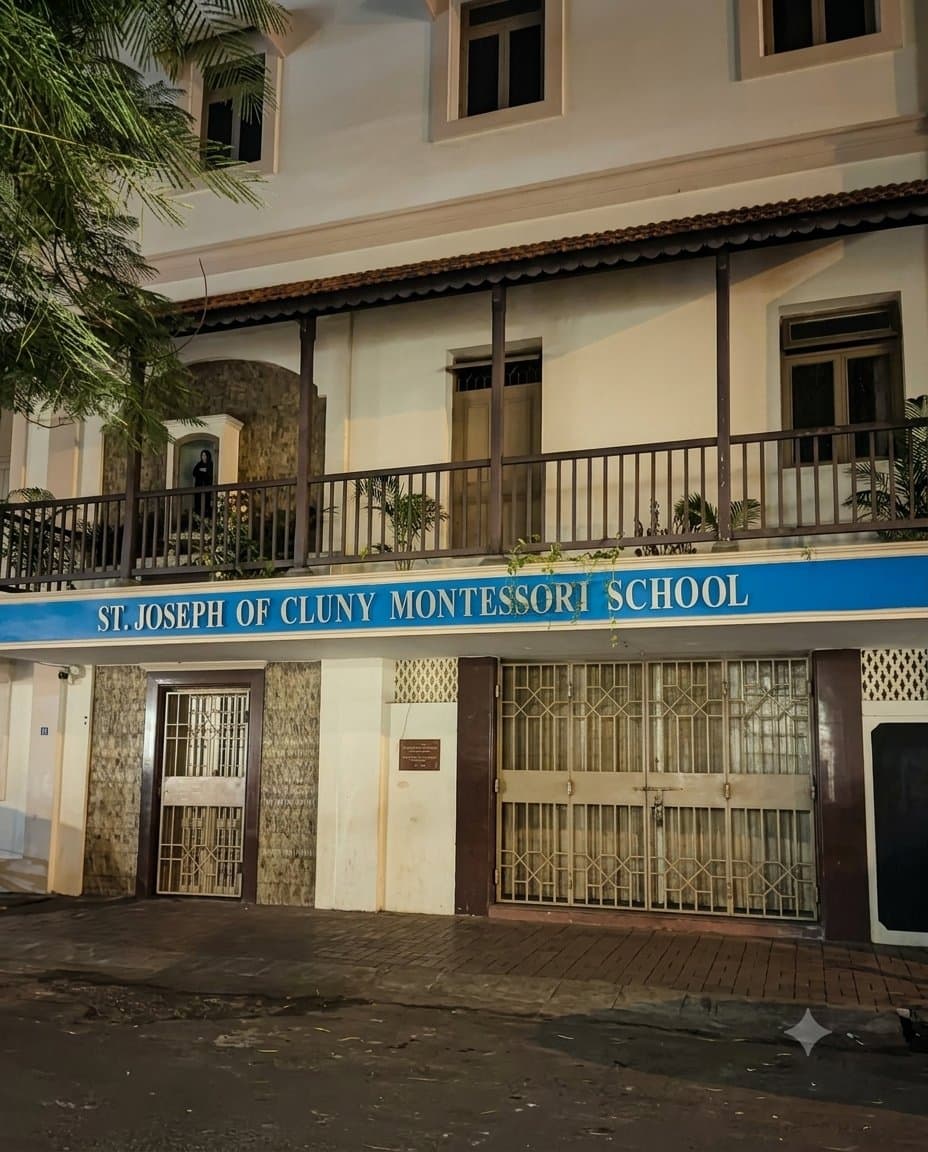
French Institution
The Cluny Schools, Pondicherry
Anne-Marie Javouhey founded her congregation in 1807 to educate girls that no one else was educating. Her sisters arrived in Pondicherry twenty years later and have been here ever since.
When Anne-Marie Javouhey founded the Sisters of Saint Joseph of Cluny in Chalon-sur-Saône in 1807, she was working against the grain of her time on almost every point that mattered. Girls' education was not considered essential. Missionary work in the colonies was considered a male domain. The dignity of enslaved and colonised people was not a subject on which French Catholic institutions typically took a public position. Javouhey took one on all three. She was beatified by the Catholic Church in 1950.
The Woman Behind the Schools
Anne-Marie Javouhey was born in 1779 in Burgundy and died in 1851, having spent the intervening decades building a congregation that reached across Africa, South America, and Asia. She is remembered in France as an abolitionist as much as an educator: she campaigned for the dignity and basic rights of enslaved people at a time when this was an extraordinary position for a French Catholic nun to hold.
Her educational philosophy was not about forming an elite. It was built around a specific conviction: that education was a form of liberation, that moral formation and practical instruction could transform the lives of children who had no other access to schooling. The core principles she embedded in the congregation, education for all especially the poor, discipline combined with compassion, the empowerment of girls, and practical preparation for real life, are still the declared foundation of Cluny schools today.
The Arrival in Pondicherry
The Cluny Sisters arrived in Pondicherry in 1826 and 1827, when the city was still unambiguously French territory. Their establishment here was not incidental. Pondicherry became the motherhouse of Cluny education in all of South Asia, the base from which the congregation organised and expanded its work across the subcontinent. From this one city, the network reached across Tamil Nadu and eventually far beyond it.
The mission they carried was specific to the setting. Pondicherry in the 1820s had European families, Creole households, Tamil Catholic communities, and a much larger non-Christian population with little access to formal schooling. Javouhey's philosophy was precisely suited to this: not an institution for the privileged, but schools for the city as a whole.
Building the Network
Throughout the nineteenth century, the Sisters steadily expanded their educational and charitable work in Pondicherry. Schools were established alongside orphanages, while teacher training and catechetical instruction formed an integral part of the congregation's mission. Education was conceived not simply as academic instruction but as the formation of character, discipline, and faith. During the colonial period, instruction was primarily conducted in French and reflected the educational traditions of the French Catholic missionary system, combining languages, domestic sciences, religious instruction, and the standard academic curriculum of mission schools.
The present-day St. Joseph of Cluny Girls Higher Secondary School was established in 1946, representing the formal organisation of an educational mission that the Sisters of St. Joseph of Cluny had been pursuing in Pondicherry for well over a century. Rather than marking the beginning of their work, the school's founding consolidated a long-established tradition of Catholic education in the city.
The Language Shift
The Cluny schools were among the French-founded institutions in Pondicherry that gradually transitioned from French to English-medium instruction following the transfer of French India to the Indian Union. The change was evolutionary rather than abrupt. As the schools became integrated into the Indian educational system, English increasingly replaced French as the principal language of instruction, while the congregation retained its longstanding emphasis on disciplined learning, moral formation, and academic excellence. French continued to be taught as an important language, even as English became the primary medium of instruction.
The evolution of language within the Cluny schools mirrors the broader political history of Puducherry itself. The gradual movement from French to English reflects the territory's transition from a French colonial possession to part of the Indian Republic, while the educational ideals established by the Sisters remained remarkably consistent across both eras.
Into Lawspet
As Puducherry expanded beyond the historic French quarter during the twentieth century, the Cluny educational network evolved with the city. Today, its principal higher secondary school is situated at Lawspet, one of Puducherry's major residential and educational districts, reflecting the city's post-independence urban growth. Alongside the higher secondary school, the Sisters of St. Joseph of Cluny continue to administer a wider network of primary and secondary schools, educational centres, and community institutions across the region, adapting their long-standing educational philosophy to the needs of contemporary Puducherry while preserving the congregation's enduring commitment to academic excellence, discipline, and service.
The Founder Who Stayed
Javouhey never visited Pondicherry. Her image appears in the schools she founded nevertheless, a reminder that the educational project her sisters have been running for two centuries has a specific origin and a specific set of commitments. The schools she set in motion are still teaching girls in a city she never saw, following a vision she formed in Burgundy at the beginning of the nineteenth century. That continuity, across empire and independence, across French and English, across colonial and national, is what the Cluny schools in Pondicherry represent.

The Pondy App
Take this guide with you
Offline maps, street-level history, restaurant picks, and hotel guides: everything on this site, in your pocket.