
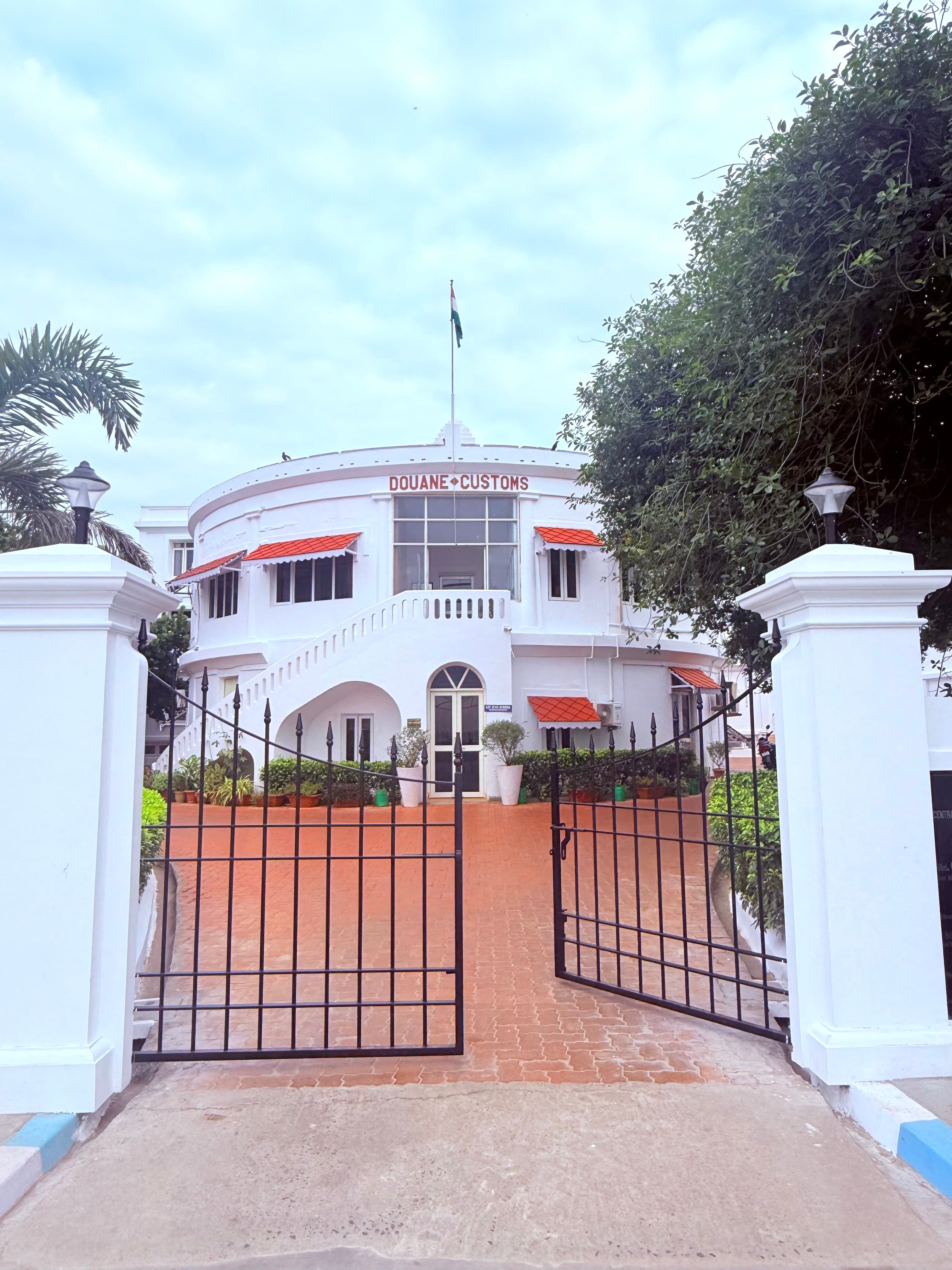
Customs Building, Pondicherry
French: La Douane
Built: Built 19th c., remodelled c.1940
A circular colonial building on Goubert Avenue that has stood at the edge of Pondicherry's seafront since the nineteenth century, overseeing the goods that passed between ship and shore. Built to manage maritime trade, remodelled in the 1940s with Art Deco detailing, it now flies the Indian national flag, and is one of the most photographed buildings on the Promenade.
The problem of the harbour. Pondicherry never had a natural harbour. Ships anchored offshore and goods came to land by small boat through the Coromandel surf: a slow, expensive, dangerous process that defined the economics of the entire colony. Managing what arrived, assessing it, taxing it, logging it, was the business of the Douane, the French Customs house, built on Goubert Avenue at the point where the seafront met the commercial life of the White Town.
The building. The original structure dates from the nineteenth century, built in the classical colonial style that characterised Pondicherry's Restoration-era public buildings: high columns, large windows, thick walls against the tropical heat. Its circular or rounded form set it apart from the rectangular blocks around it, giving it an immediate visual authority on the seafront. In around 1940, the building was remodelled, its upper register acquiring the geometric detailing and streamlined ornament of Art Deco, a style that was already reaching its late phase in France but was still arriving in the colonial world. The two vocabularies sit together without contradiction: classical proportions below, Art Deco refinement above.
What it handled. Everything that came off a ship and into Pondicherry passed through the administrative jurisdiction of this building: textiles, spices, wine, machinery, personal effects, correspondence. And everything that left, too. The tax revenue collected here funded a significant portion of the colonial administration. The building was not merely decorative. It was the commercial nervous system of the entire comptoir, sitting between the port and the city.
After 1962. When Pondicherry passed to India, the building continued in official use. Today it operates under the Indian government, the national flag flying from its facade, its function in customs and port administration continuing in a modified form. The commerce it oversees has changed; the building has not. It remains on the Promenade exactly where the French placed it, one of the few colonial public buildings on Goubert Avenue still in active official use, and one of the most photographed stops on the seafront walk.
What to look for
- The circular form is unlike almost anything else in the White Town grid. Stand back on Goubert Avenue and look at the proportions: this was designed to be seen from the sea, before you reached the shore.
- Two architectural moments in one building: nineteenth-century colonial classicism in the structure, 1940s Art Deco in the upper detailing. The remodelling happened just two years before the Japanese occupation of French Indochina changed the colonial world forever.
- Still in official use. The Indian flag over a French colonial customs house on a seafront where the British once anchored offshore. Three sovereignties, one building, still open.
Hours: Exterior visible from Goubert Avenue at all times (active government building, interior not public)
Entry: Free to view from outside
Tip: Best photographed in the morning with the light coming from the east. Walk the Promenade from here south toward Notre-Dame des Anges for the full colonial seafront sequence.

The Pondy App
Take this guide with you
Offline maps, street-level history, restaurant picks, and hotel guides: everything on this site, in your pocket.