
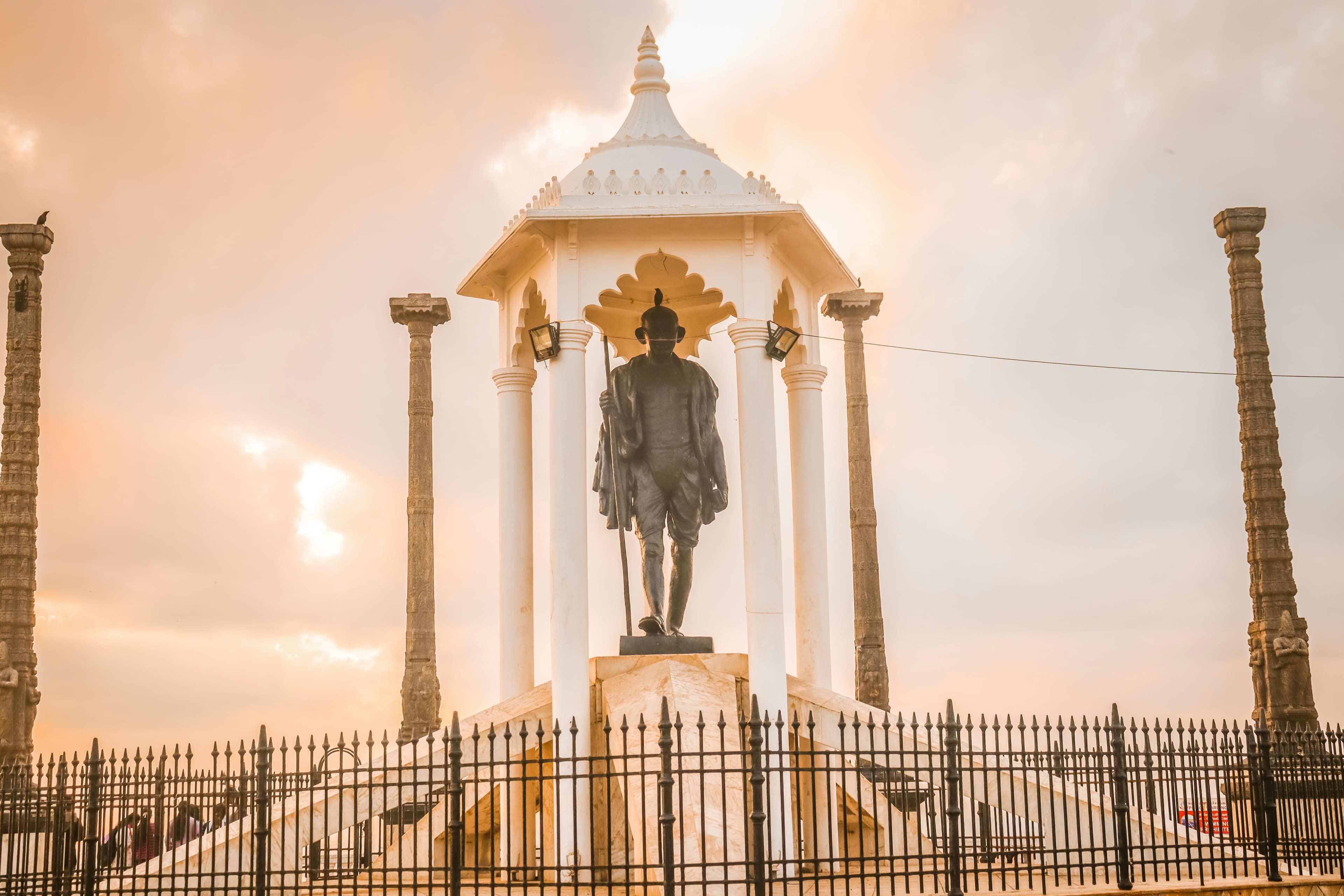
Gandhi Statue, Pondicherry
Built: Unveiled 26 January 1965
You are looking at the Gandhi statue on Goubert Avenue, unveiled on Republic Day, 26 January 1965, and standing on eight granite pillars that are more than 300 years old. The pillars were brought from Gingee Fort in Tamil Nadu during the French colonial era. The square around it is called Gandhi Thidal. Local legend says a tunnel runs beneath the statue all the way back to Gingee Fort. It has never been opened.
The bronze statue, 13 feet tall, was sculpted by Debiprasad Roy Choudhury of the Madras School of Art and unveiled on Republic Day, 26 January 1965, three years after the de jure transfer of Pondicherry to India. It stands on Goubert Avenue facing the Old Port Pier, in what is now called Gandhi Thidal, the open square that serves as Pondicherry's main venue for cultural events and national celebrations.
The eight monolithic granite pillars surrounding the statue are older than the city itself in its French form. Brought from Gingee Fort in Tamil Nadu during the French colonial era, they predate the statue by more than three centuries. Gingee Fort was one of the great fortresses of South India, held at different times by the Marathas, the Mughals, the French, and the British. The French brought these pillars to Pondicherry; they ended up as the base of a monument to the man who ended French India.
The statue stands metres from the Dupleix statue to the north, and close to the Nehru statue. The juxtaposition is unplanned but eloquent: Dupleix tried to prevent British dominance over India through French military power. Gandhi dismantled British power through non-violent resistance. Nehru built the independent state that followed. Three men, three centuries, the same seafront.
Local legend adds one detail that no guide can verify: a tunnel beneath the statue, said to run all the way back to Gingee Fort. It remains closed off.
What to look for
- Bronze statue, 13 feet tall, sculpted by Debiprasad Roy Choudhury of the Madras School of Art. Unveiled Republic Day, 26 January 1965.
- The eight granite pillars are over 300 years old, brought from Gingee Fort during the French colonial era. The fort that France once held now frames the statue of the man who ended French India.
- The square is called Gandhi Thidal: Pondicherry's main space for cultural events and national celebrations.
- Faces the Old Port Pier, where ships once anchored offshore and goods came in by small boat through the surf.
- Local legend: a tunnel beneath the statue runs to Gingee Fort. It has never been opened.
- Metres away: the Dupleix statue to the north, the Nehru statue nearby. Three centuries of Indian history on one boulevard.
Hours: Open 24h
Entry: Free
Tip: Look at the pillars before you look at the statue. They are older than anything else on the Promenade and came from a fort that France once held. The statue arrived 300 years later.

The Pondy App
Take this guide with you
Offline maps, street-level history, restaurant picks, and hotel guides: everything on this site, in your pocket.