
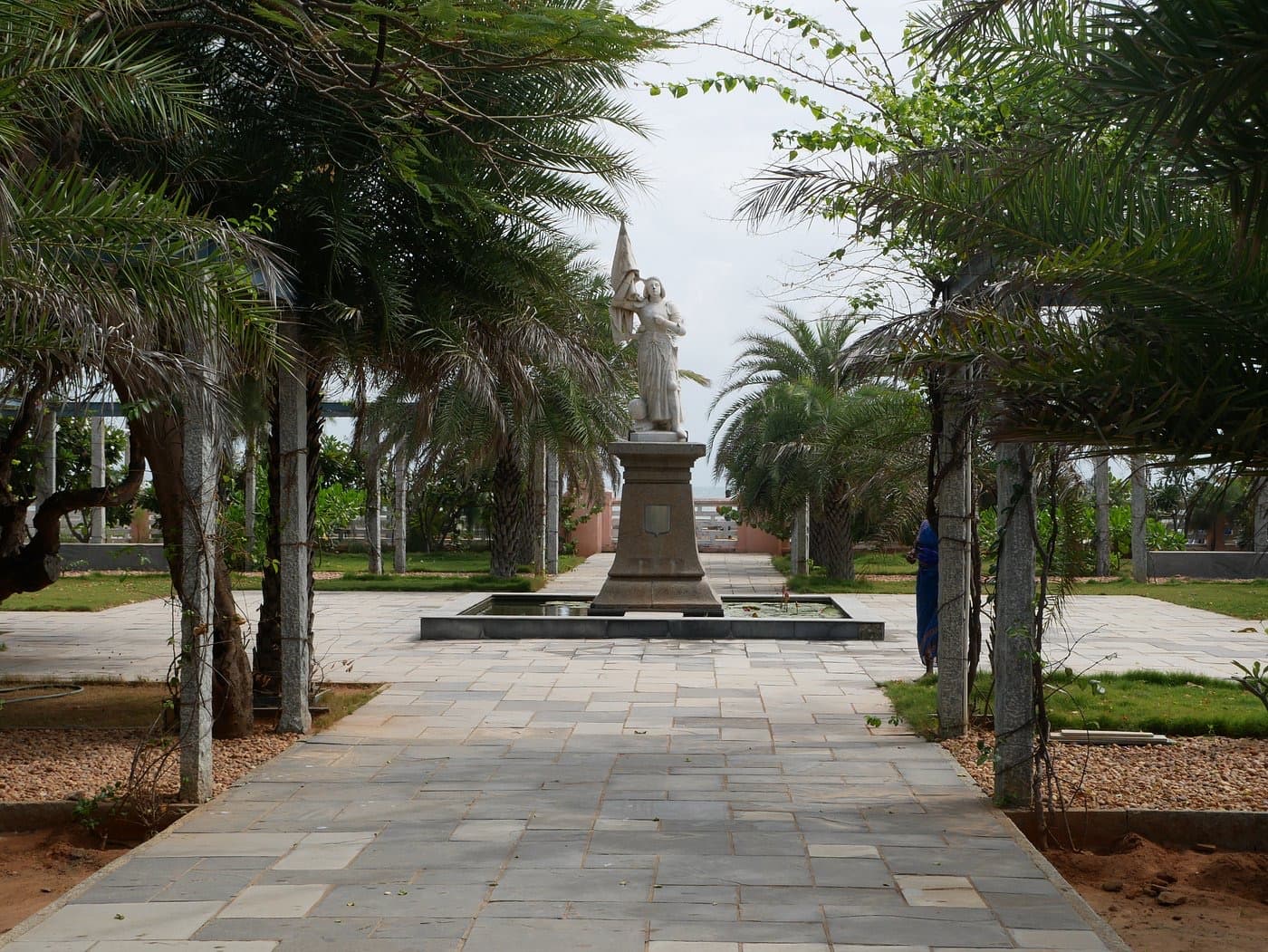
Joan of Arc Statue, Pondicherry
French: Statue de Jeanne d'Arc
Built: 1920
You are looking at a white marble statue of Joan of Arc in the small garden opposite Notre-Dame des Anges, where the promenade meets Rue Dumas, donated in 1920 by François Gaudart, the wealthiest industrialist French India ever produced. Joan expelled the English from France in the 15th century. The English razed Pondicherry in 1761. The symbolism was deliberate.
The statue was donated by François Gaudart (1844–1923), founder of the Forges et ateliers Gaudart-Sainte-Élisabeth, a metallurgical works that at its peak employed up to 4,000 Indian workers. When Gaudart sold the business in 1919 for approximately 75 million francs, it was one of the largest private transactions in the history of French India. He received the Légion d'honneur in 1914 and died in Cannes in 1923, three years after commissioning this statue.
The occasion was the canonisation of Joan of Arc by Pope Benedict XV on 16 May 1920, two years after the Armistice. Joan's image resonated in Pondicherry with a particular force. The same English whose East India Company had besieged this city four times, razed it to the ground in 1761, and systematically dismantled French power in India had been defeated in the First World War. The Virgin of Orléans who had expelled the English from France found a natural home on the Coromandel Coast.
The statue faces Notre-Dame des Anges across Rue Dumas, her back to the Bay of Bengal, standing in a small garden bordered by the promenade and the street rather than attached to the church itself. It is in white marble rather than local coral stone, a material choice that signals both Gaudart's wealth and his intention to build something permanent. It became the focal point of an annual gathering on Joan's feast day (30 May). Under Gaullist Governor Charles Baron during the Second World War, that gathering became an explicit act of resistance and a rallying point for French India's Free France movement.
The garden is still alive with the French community. On most mornings, retired Franco-Pondicherrians of French origin gather here to play pétanque beneath the statue. Joan of Arc looks on. It is one of the most quietly French scenes in Pondicherry.
What to look for
- White marble, not local coral stone: Gaudart commissioned something built to last.
- Canonised 16 May 1920: the occasion for the gift. Joan expelled the English from France; the English razed Pondicherry in 1761.
- Faces Notre-Dame des Anges across Rue Dumas, in a garden bordered by the promenade and the street, not attached to the church itself.
- Donor François Gaudart sold his metallurgical works in 1919 for 75 million francs: the largest private fortune French India produced.
- Under Governor Baron in WWII, the annual Joan of Arc gathering became a Gaullist commemoration and statement of resistance.
- Retired Franco-Pondicherrians still play pétanque in this garden most mornings. One of the most quietly French scenes in the city.
Hours: Visible 24h from Rue Dumas; church open daily
Entry: Free
Tip: Come in the morning for softer light, and there is a good chance you will find a game of pétanque in progress under Joan of Arc.

The Pondy App
Take this guide with you
Offline maps, street-level history, restaurant picks, and hotel guides: everything on this site, in your pocket.