
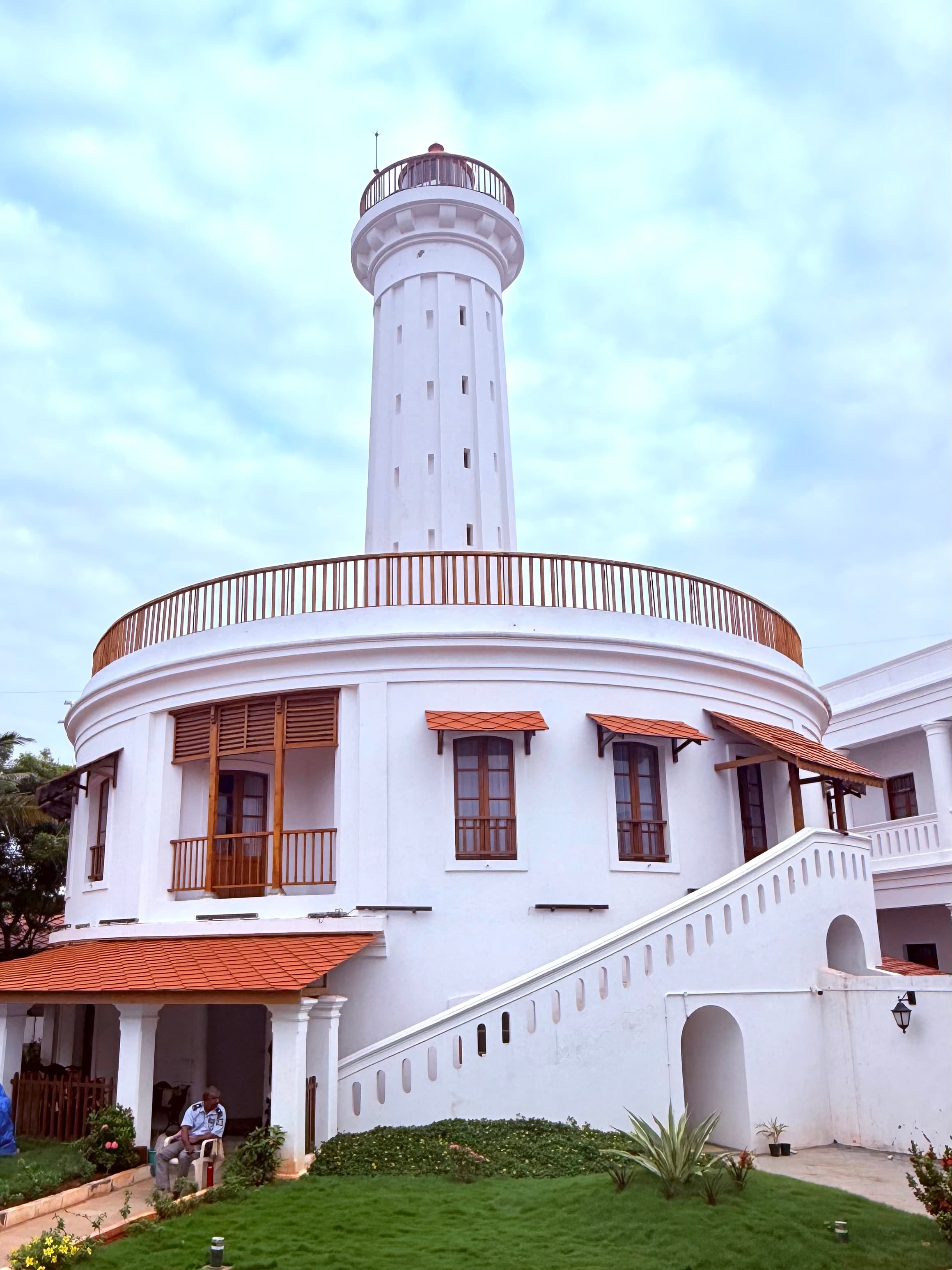
Old Lighthouse, Pondicherry
French: Phare de Pondichéry
Built: Built 1835–1836
Built in 1836 by colonial engineer Louis Guerre and standing 29 metres tall, the Old Lighthouse guided ships through the treacherous Coromandel surf for 143 years. Reopened to the public in June 2026 after decades closed, you can now climb to the top for a panoramic view of the Bay of Bengal and the White Town, then come down to the café that has opened inside.
The Coromandel Coast presented a navigation problem that killed sailors for centuries: a flat, featureless, surf-beaten shore with shifting sandbanks, no natural harbour, and nothing visible at night. Pondicherry's commercial existence depended on ships finding the offshore anchorage safely and transferring goods by small boat through the surf. A reliable light on this shore was not a luxury.
Louis Guerre, the most significant French colonial engineer of the Restoration and July Monarchy period in Pondicherry, built the lighthouse in 1835 to 1836 under Governor Saint Simon. At 29 metres, with oil lamps and reflectors visible approximately 15 miles out to sea, it gave approaching ships a navigational fix at night for the first time. The square base, thick coral-stone walls, and warm ochre render place it in the same architectural family as every other significant French building of the era.
Guerre is remarkable for the range of what he built: the lighthouse in 1836 and Notre-Dame des Anges in its current form in 1851 to 1855. No other single engineer left as visible a mark on the White Town's nineteenth-century built environment. Stand at the lighthouse and look north along the Promenade: the church tower is visible from here. Same hands, same stone, same decade.
The lighthouse operated for 143 years, through two world wars, Indian independence, and the transfer of Pondicherry in 1962. It was decommissioned in 1979 when a new black-and-white striped lighthouse was built about 2 km south in Dubrayapet. For decades it stood closed to the public, a landmark on the Promenade that could only be admired from outside. In June 2026 it reopened: visitors can now climb the internal staircase to the top for a sweeping view of the Bay of Bengal and the rooftops of the White Town below. A café has opened inside the base of the building, making it a natural stop to sit and recover after the climb.
What to look for
- Built 1836 by Louis Guerre, who also designed Notre-Dame des Anges. Same engineer, same coral stone, same era.
- 29 metres tall, visible 15 miles at sea. Operated for 143 years without interruption.
- Reopened June 2026: climb to the top for the best elevated view of the Bay of Bengal and the White Town grid from the Promenade.
- A café is now open inside the base. Come down from the climb, sit down, and look out at the sea.
Hours: Check locally for current opening hours (reopened June 2026)
Entry: Check locally for current entry fee
Tip: Climb first, café after. The view from the top is the best free elevated panorama in the White Town. The same engineer built Notre-Dame des Anges: look north from the top and you will see its twin towers directly.

The Pondy App
Take this guide with you
Offline maps, street-level history, restaurant picks, and hotel guides: everything on this site, in your pocket.