
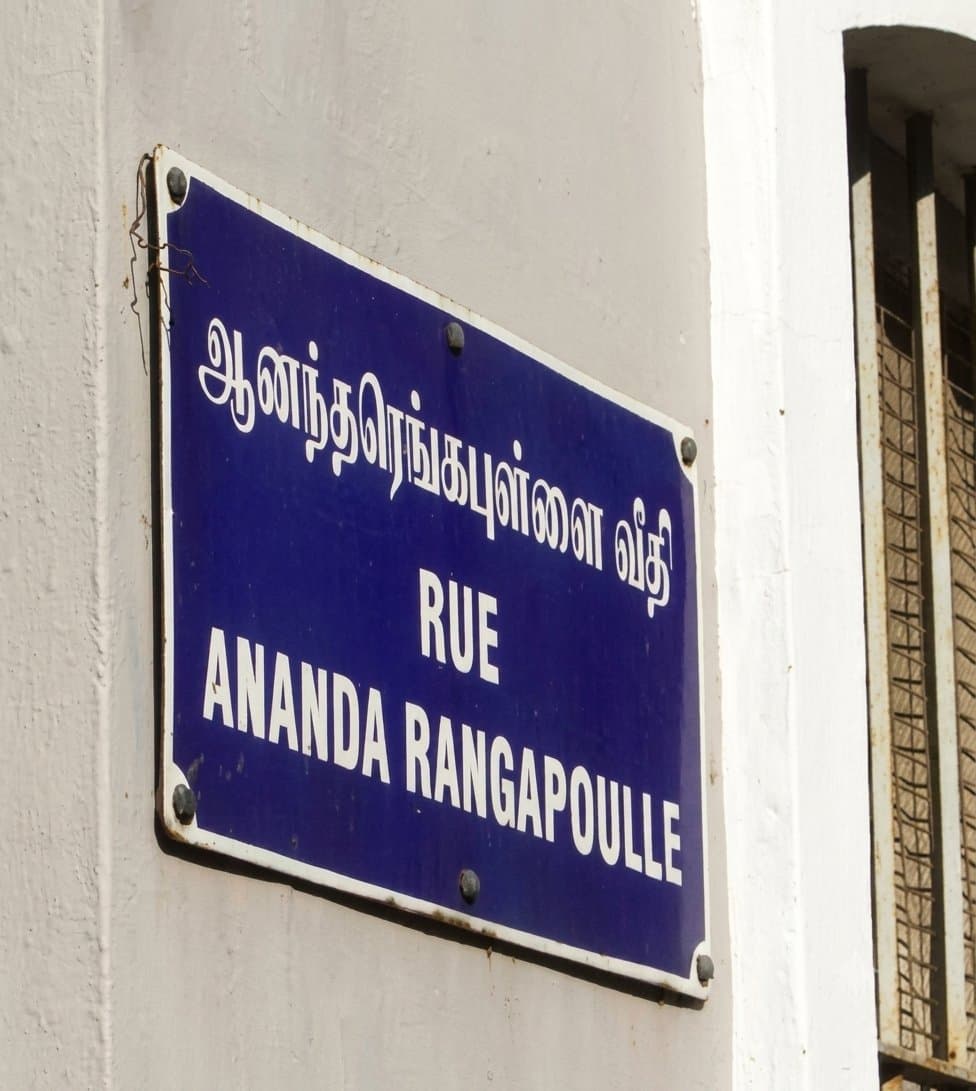
East–West Street
Ananda Ranga Pillai Street, White Town, Pondicherry
Named after: Ananda Ranga Pillai (1709-1761), dubash to Dupleix and author of the most important Indian diary of the French colonial period (1709–1761)
Welcome to Ananda Ranga Pillai Street, named after the man who ran French India from the inside. He was not French. He was the dubash, the chief broker and interpreter of the Compagnie des Indes, the Indian without whom the French colonial machine would not have turned. He also kept a diary. Twelve volumes, in Tamil. His house, built in 1735, is still on this street.
The word dubash means 'two languages' in Tamil, but the role was far more than translation. Ananda Ranga Pillai (1709-1761) was the essential human interface between the French and the Indian commercial and political world: he managed networks, extended credit, negotiated with local officials, gathered intelligence, and served as Dupleix's eyes and ears in the Tamil community. He served under four Governor-Generals and during Dupleix's tenure was made Diwan, councillor and chief of the Indians. He was wealthy, well-connected, and absolutely indispensable.
He was also writing everything down. His private diary, kept in Tamil and running to twelve published volumes, is the single most important Indian primary source for the French colonial period. He wrote with no European audience in mind, which means he wrote with a candour that no official document could match. When Dupleix vented his fury at La Bourdonnais after the capture of Madras in 1746, Pillai recorded it in direct speech. When tension gripped the bazaar before a battle, Pillai captured it. The diary covers 1736 to 1761: the entire arc of French India from its peak to its collapse.
His assessment of Dupleix's predecessors is the most-quoted passage in the historiography of French India. Of Lenoir: he enriched the earth, planted trees, enjoyed the fruit. Of Dumas: he simply devoured the produce. Of Dupleix's time: a tempest devoured the garden.
Pillai died in 1761, the year Pondicherry fell to the British. He witnessed everything. His diary was not translated until 1904 to 1928, when the Government of Madras published it in English. His house, a fine example of Franco-Tamil architecture built in 1735, still stands on this street.
Notable on this street
- His house is still here. Built in 1735, it is one of the very few eighteenth-century buildings surviving in modern Pondicherry. Franco-Tamil architecture: look for it.
- The dubash was the essential interface between France and India. Without Pillai, the French colonial machine could not have functioned. He was not a servant. He was a partner.
- His diary runs to twelve volumes in Tamil. It is the only sustained Indian account of the French colonial period written from the inside.
- The gardener quote: Lenoir enriched the soil. Dumas ate the fruit. Under Dupleix, a tempest devoured the garden. Pillai wrote this about the men whose orders he carried out.
- He recorded Dupleix's private fury at La Bourdonnais after the capture of Madras in 1746: candid words no official document preserved. We know what Dupleix said in private because Pillai wrote it down in Tamil.
- He died in 1761, the same year Pondicherry fell. He witnessed the entire arc: the peak, the wars, the siege, the end.

The Pondy App
Take this guide with you
Offline maps, street-level history, restaurant picks, and hotel guides: everything on this site, in your pocket.