
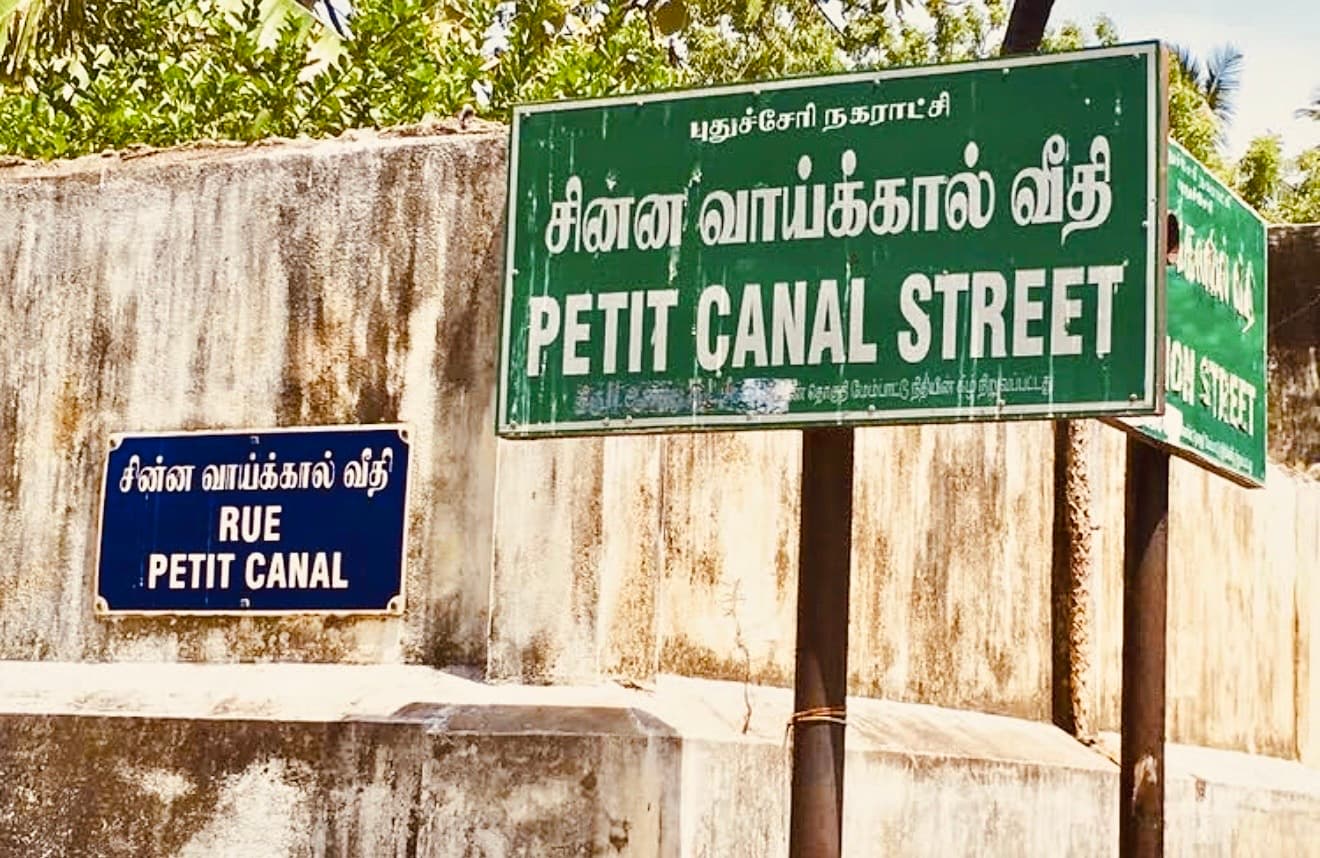
East–West Street
Petit Canal Street, White Town, Pondicherry
Also known as: Rue du Petit Canal
Named after: The Petit Canal, the drainage and stormwater channel that historically marked the boundary between the colonial White Town and the Tamil Black Town
Welcome to Petit Canal Street. The canal this street is named after was not a waterway in the Venetian sense: it was a drainage channel, a stormwater ditch, and above all a boundary line. The Grand Canal to the west separated the White Town from the Tamil quarter. The Petit Canal was its smaller tributary, marking the edges of that division in both directions. Today the canal system is partly covered, partly landscaped, and entirely worth understanding.
Pondicherry was built on a flat coastal plain with no natural gradient to carry rainwater to the sea. The French colonial administration engineered a canal system that served two purposes simultaneously: stormwater drainage and social segregation. The Grand Canal, running north-south, was the principal line: to its east lay the White Town, the French quarter of ordered streets and colonial institutions; to its west lay the Black Town, the Tamil quarter of temples, bazaars, and the Indian population that provided the labour, trade, and craft on which the entire colony depended.
The Petit Canal was the smaller drainage channel running roughly east-west, a tributary of the Grand Canal system. Its name simply distinguished it from the Grand Canal: the small drain, against the large one. But in Pondicherry's colonial geography, size was not the point. The canal network as a whole was the physical infrastructure of segregation: it marked where the French city ended and the Indian city began, and it made that boundary visible and difficult to cross casually.
After 1962, as the city grew and the legal distinctions between communities dissolved, the canal became primarily a civic engineering problem. Parts were covered, parts landscaped, parts converted into storm drains. The street that carries the Petit Canal's name now runs through an area that sits between the Tamil and French quarters, a reminder of the boundary the canal once marked. Wall art installations along parts of the canal today make it one of the more photographed stretches of the city for a very different reason than it was built.
Notable on this street
- The canal system served two purposes: stormwater drainage and colonial segregation. The Grand Canal was the main dividing line between White Town and Black Town.
- The Petit Canal was the smaller tributary, running roughly east-west. Its name is purely descriptive: the small drain, against the grand one.
- Wall art installations along the canal today make it one of the more photographed stretches in Pondicherry. The French colonialists who designed it for segregation would not recognise the use.
- After 1962 parts of the canal were covered or landscaped. The boundary it once marked still shapes the city's geography even where the water is no longer visible.

The Pondy App
Take this guide with you
Offline maps, street-level history, restaurant picks, and hotel guides: everything on this site, in your pocket.