
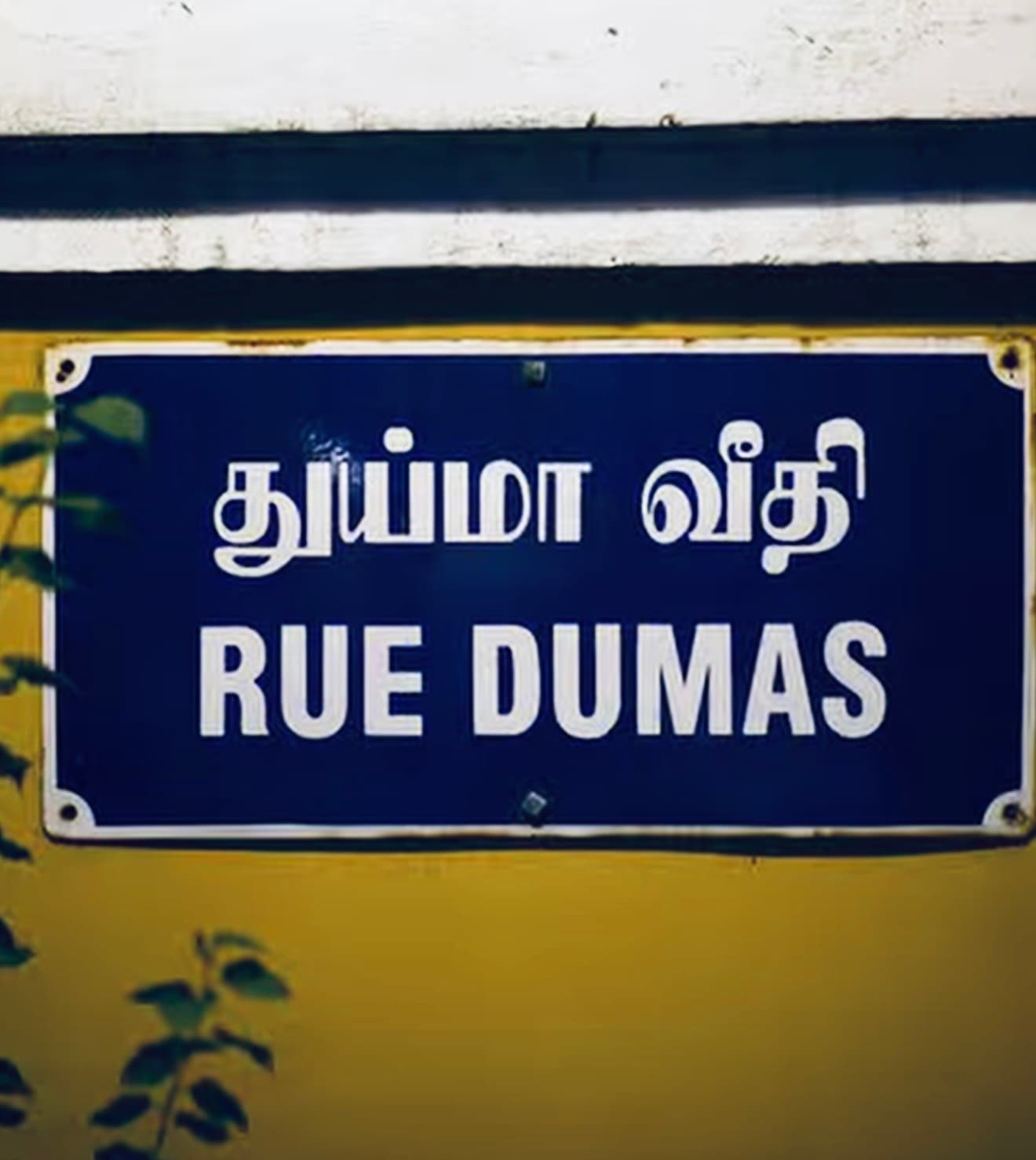
North–South Street
Rue Dumas, White Town, Pondicherry
Named after: Pierre Benoît Dumas, Governor-General 1735–1741 (1696–1745)
Welcome to Rue Dumas, named after the Governor-General who built the palace, secured a second harbour, and handed Pondicherry to Dupleix in better condition than he found it. On your right: Notre-Dame des Anges, the oldest church in French Pondicherry. In the small garden opposite the church, where the street meets the seafront: a white marble Joan of Arc. France had a patron saint even here.
You are walking on a street named after a man who governed French India from 1735 to 1741, the quiet years between the founding era of François Martin and the imperial gamble of Dupleix. Pierre Benoît Dumas (1696–1745) was the consolidator: he strengthened the city's fortifications, cultivated the Nawab of the Carnatic, and in 1739 persuaded the Nawab of Tanjore to cede Karikal, giving France a second coastal settlement with a better natural harbour and access to the rice-rich Tanjore delta. Then he left the city to Dupleix. Everything that followed was built on what Dumas had secured.
His most visible legacy is the Governor's Palace: he initiated what is now Lok Nivas in 1738. But step off the street for a moment. The church ahead of you, Notre-Dame des Anges, has stood on this site since 1687, though the current building dates from 1855. Every governor who ever lived in Pondicherry would have walked past it. Now go find the small garden opposite the church, where the street meets the seafront. Standing there is a white marble Joan of Arc, facing the church, installed in April 1923, three years after Joan was canonised. France, a republic, named streets after her. France, a colonial power, sent her statue to India. Go figure.
The Alliance Française is also on this street: French language courses and cultural events in the same block as a 17th-century church and an Orléanist saint. This is the most French street in Pondicherry.
Notable on this street
- Look for the Joan of Arc statue, not inside the church but in the small garden opposite it, where the street meets the seafront. She arrived April 1923, and faces the church. Find her.
- Notre-Dame des Anges has stood on this site since 1687, before Dupleix, before the Dutch occupation, before almost everything. The current facade dates from 1855.
- The Alliance Française is on this street. Ask them what courses they run; some are free or low-cost for visitors.
- Dumas initiated Lok Nivas (then called Raj Nivas) in 1738. The palace still stands one block west, in the park.

The Pondy App
Take this guide with you
Offline maps, street-level history, restaurant picks, and hotel guides: everything on this site, in your pocket.