
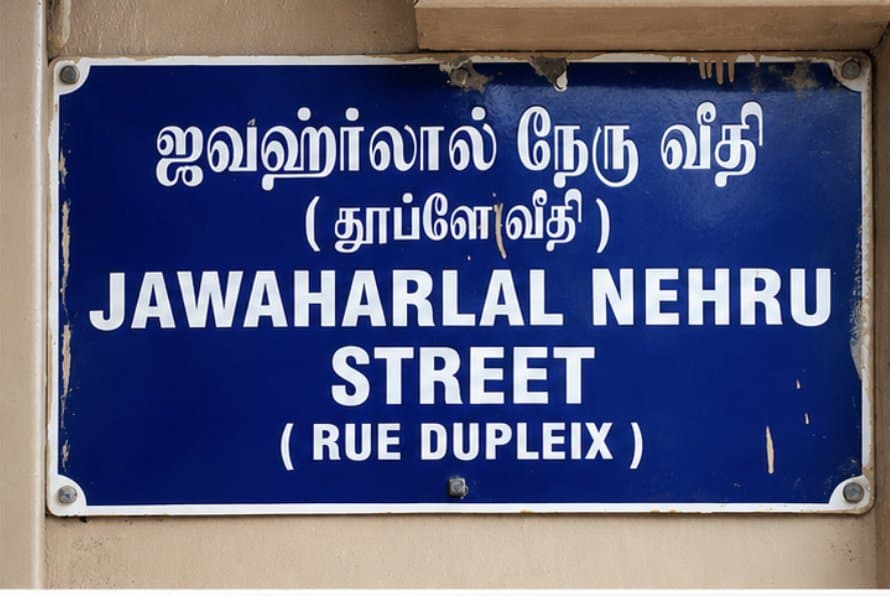
East–West Street
Jawaharlal Nehru Street, White Town, Pondicherry
Also known as: ex-Dupleix Street
Named after: Joseph François Dupleix, Governor-General 1742–1754 (1697–1763)
You are on Jawaharlal Nehru Street, the main east-west axis of the White Town and the busiest shopping street in Pondicherry. The French name was Rue Dupleix, and older Pondicherrians sometimes still call it that. It carries the weight of two histories: the French governor who nearly made this city the capital of an empire, and the Indian prime minister who built the country that absorbed it.
You are walking on a street with two names, and both matter. The official name is Jawaharlal Nehru Street. The old French name was Rue Dupleix, and you may still hear older residents use it. Between them they tell you most of what you need to know about Pondicherry.
Joseph François Dupleix arrived as Governor-General in January 1742 and for twelve years ran the most ambitious European project in eighteenth-century India: a protectorate over the Carnatic and Deccan, backing Indian succession candidates with French troops, French-trained sepoys, and French political recognition. At its peak in 1750, Pondicherry was the constitutional capital of the Deccan. His own company fired him in October 1754. He died in Paris on 13 November 1763, broke, on the same day the Treaty of Paris formally ended French territorial ambitions in India.
Today this street is Pondicherry's commercial main artery: textile shops, jewellers, sari stores, pharmacies, restaurants, street food. The man who wanted territorial sovereignty over south India has his memory on a shopping street. Walk east to the seafront and you find three statues on the Promenade: Dupleix, Gandhi, Nehru. Colonial ambition, independence, and the republic that followed. The same boulevard. Nobody planned it that way. It happened anyway.
Notable on this street
- This is Pondicherry's main shopping street. Textiles, jewellery, saris, pharmacies, street food. If you need anything, you will find it here.
- The Promenade at the eastern end of this street has three statues: Dupleix, Gandhi, and Nehru. The man who tried to keep India French, the man who made Britain leave, and the man who built the republic that absorbed Pondicherry. Walk there.
- At his peak in 1750, Dupleix held Mughal imperial authority over all of south India from the Krishna River to Cape Comorin. The grant was made in Pondicherry, in the palace one block north of this street.
- Older Pondicherrians sometimes still call this Dupleix Street. The name changed; the memory didn't.

The Pondy App
Take this guide with you
Offline maps, street-level history, restaurant picks, and hotel guides: everything on this site, in your pocket.