
North–South Street
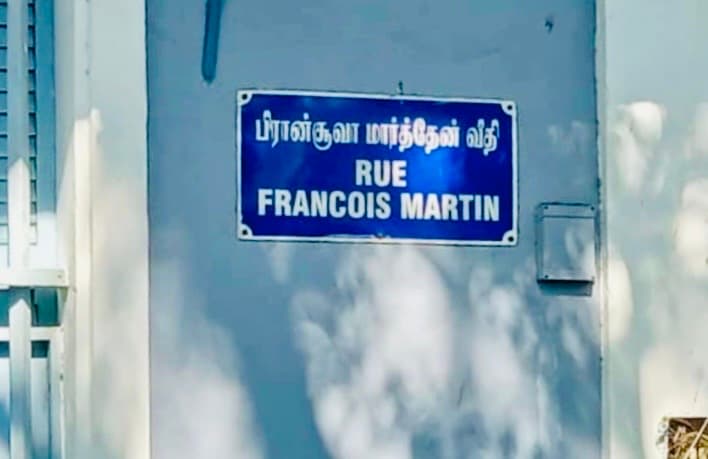
Rue François Martin, White Town, Pondicherry
Named after: François Martin, founder of French Pondicherry (c.1634–1706)
Welcome to Rue François Martin, named after the man who founded French Pondicherry. He left France in 1665 and never went back. When everyone else evacuated in 1674, he stayed with six men and refused to give up the site. That decision is why this street exists.
You are walking on a street named after a man who held this city with six soldiers and pure stubbornness. François Martin (c.1634–1706), born in Paris, the son of a merchant, joined the French East India Company as a junior factor. He worked his way up the Coromandel Coast and in 1673 negotiated the cession of the Pondicherry site from Chirkhan Loudy, the Bijapuri governor of Valgondapouram. He had his foot in the door.
Then in September 1674, French forces evacuated after the fall of San Thomé, the Portuguese settlement that is now a neighbourhood of Chennai, 150 km north of here. Every senior officer left. Martin stayed with six men on a site the Dutch would have occupied the moment it was empty. That refusal is the true founding moment of French India. Not the treaty, not any order from Paris. One man who decided not to leave.
The Dutch caught up with him anyway. They captured Pondicherry in 1693 and took him prisoner to Batavia. He survived, found refuge at Chandernagor, and returned in 1699 after the Treaty of Ryswick. He died in office on 30 December 1706 and was buried in Fort Saint-Louis, the fort he had built. He never returned to France. He is buried in the city he refused to abandon.
Notable on this street
- Lok Nivas, the Lieutenant Governor's official residence, faces this street from the south. Martin built the city. Others governed it. The palace went up thirty years after his death.
- The grid you are standing on is Dutch, not French. Jean Deloche's research established that the orthogonal layout was designed during the Dutch occupation of 1693–1699. Martin returned from Batavia and built his city on a Dutch plan. The street names are French. The geometry is not.
- Martin's three-volume Mémoires (1665–1696) are the most important single primary source for early French India. He wrote them while governing. The man held a city and kept a diary.
- He never went home. He is buried in the city he refused to abandon in 1674. Fort Saint-Louis no longer stands, but the grid he laid out still does. You are walking on it.

The Pondy App
Take this guide with you
Offline maps, street-level history, restaurant picks, and hotel guides: everything on this site, in your pocket.