
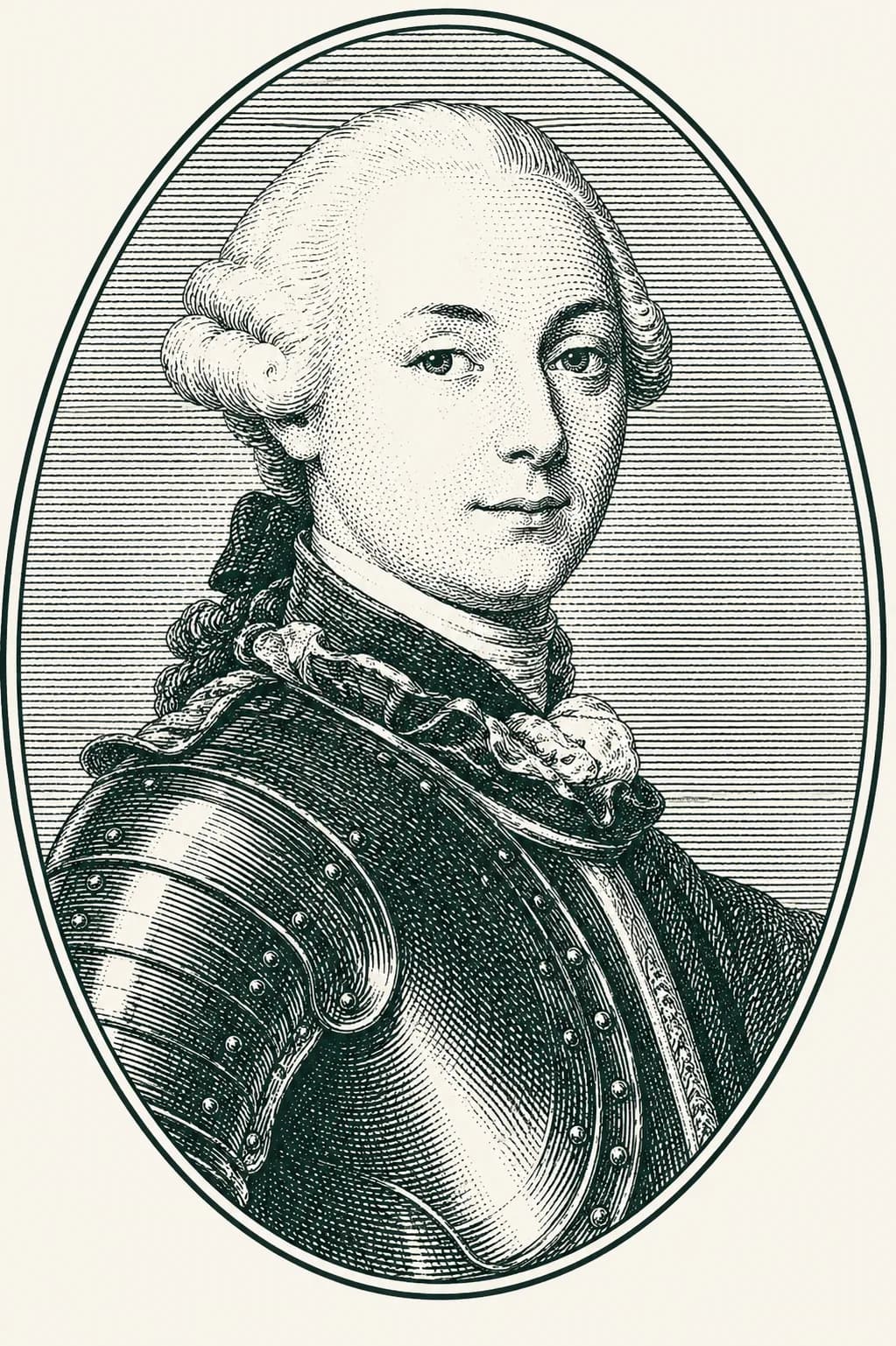
1718–1785
Charles de Bussy, Pondicherry
French Military Commander in the Deccan
Dupleix's most gifted officer, who administered a French protectorate at Hyderabad for eight years with barely two thousand men, whose recall destroyed everything he had built.
EIGHT YEARS AT HYDERABAD
Charles Joseph Patissier, Marquis de Bussy-Castelnau, was born in 1718 in Clermont in southern France and entered French India Company service in the 1730s. He was identified early as an officer of exceptional political intelligence, a quality rarer in Company service than military competence. By the time Dupleix chose him for the Deccan mission in 1750, Bussy was thirty-two, trusted with the most sensitive operations of the French Indian enterprise, and possessed of a quality his colleagues largely lacked: the patience to treat Indian political relationships as requiring cultivation over years rather than demands backed by guns.
His achievement at Hyderabad was remarkable. He maintained a small French contingent, never more than two thousand men, at the court of successive Nizams for eight years, providing the military guarantee without which no claimant to the Hyderabad throne could feel secure. In 1753 he extracted from the Nizam the cession of the Northern Circars: four coastal districts on the eastern seaboard north of the Coromandel, the largest territorial grant France ever received in India, giving French interests a corridor of coastline that Bussy then developed with characteristic care.
In 1758 Lally recalled him from Hyderabad to serve in the Carnatic campaign. Bussy argued strenuously against the order, warning that abandoning the Deccan position would undo everything eight years of patient work had built. He was overruled. Within months of his departure, the Nizam defected to the British and the Northern Circars were taken. History has almost universally agreed with Bussy's assessment of the recall.
He was captured at the Battle of Wandiwash in January 1760 and spent three years as a British prisoner. He returned to France, lived through the peace, and in 1782 was sent back to India to lead a French expedition during the American Revolutionary War, arriving in Pondicherry, aged sixty-four, only to find the peace already agreed. He died in Pondicherry on 7 January 1785, the city now reduced to a commercial enclave, a long distance from the Hyderabad court where he had spent the best years of his career. Rue Bussy, one of the principal streets of the White Town, carries his name.

The Pondy App
Take this guide with you
Offline maps, street-level history, restaurant picks, and hotel guides: everything on this site, in your pocket.