
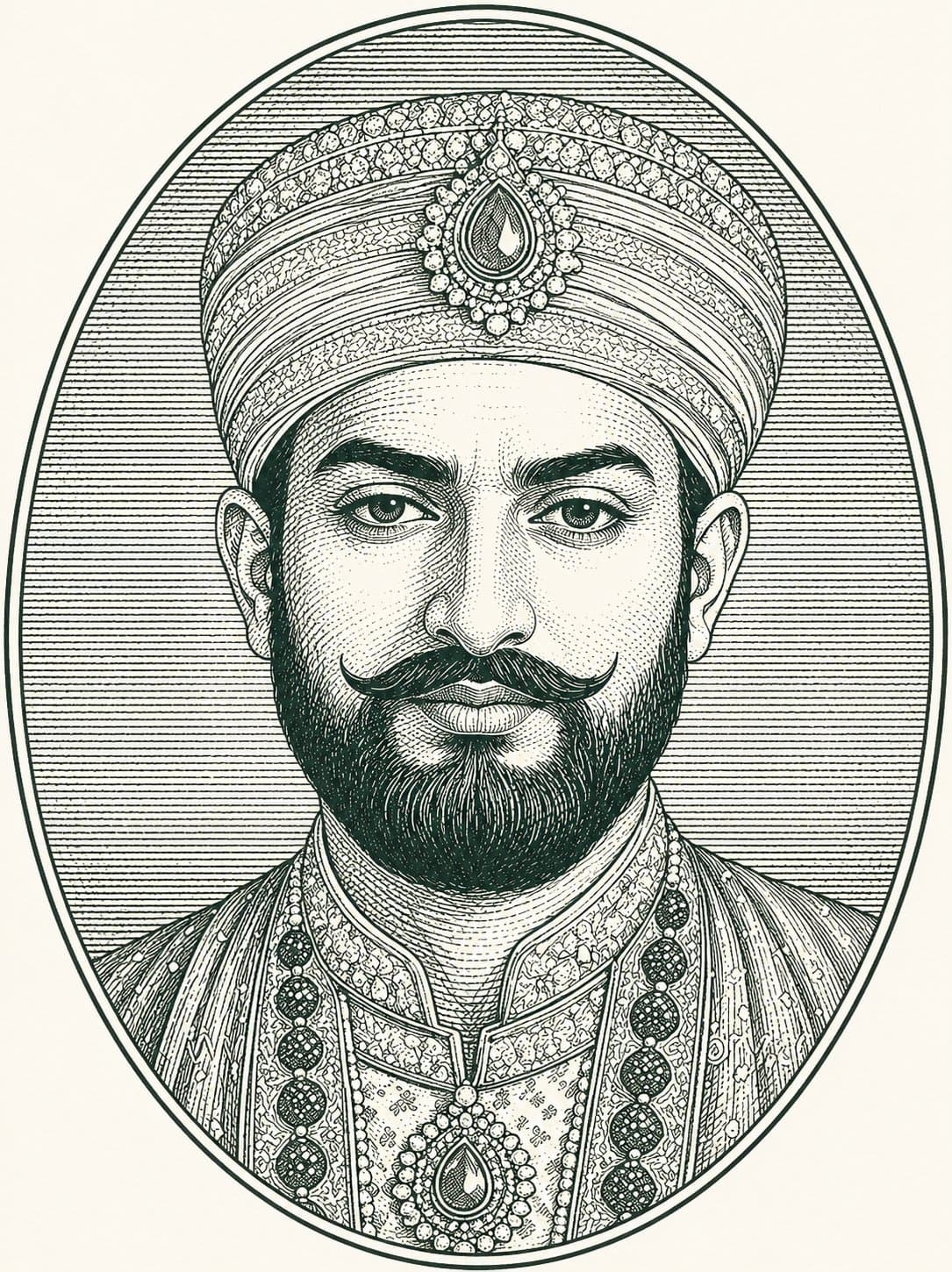
died 1752
Chanda Sahib, Pondicherry
Nawab of the Carnatic, French Ally
Dupleix's chosen Nawab of the Carnatic, whose rise and fall over three years defined the decisive phase of the Carnatic Wars, and whose death ended French dominance in southern India in a single afternoon.
THE FRENCH-BACKED NAWAB
Chanda Sahib, born Husayn Dost Khan, was son-in-law to Dost Ali Khan, Nawab of the Carnatic, and had served as his Dewan and senior military commander. He knew the political geography of southern India from the inside. His career had already demonstrated this knowledge: in the early 1730s he led a successful expedition deep into the south, reaching Madurai and extracting from the King of Tanjore a cession of the French settlement at Karikal, a grant recorded on 14 February 1739, fifteen years before anyone associated Karikal specifically with the Dupleix alliance. When Dupleix needed a credible Indian claimant with genuine Mughal legitimacy and deep Carnatic connections, Chanda Sahib had exactly the credentials required.
His path to power had been interrupted by seven years of Maratha captivity after the Maratha general Raghuji Bhonsle invaded the Carnatic in 1740 and seized him at the siege of Trichinopoly. He was held prisoner until 1748. He returned to a transformed world: the War of the Austrian Succession had ended, the French had captured and been forced to return Madras, and Dupleix was actively searching for an Indian ally with a credible claim to the Nawabship. The timing was exact: Chanda Sahib's release from captivity coincided precisely with Dupleix's moment of maximum strategic need.
At the Battle of Ambur on 3 August 1749, a combined French-Mysorean force defeated and killed Anwaruddin Khan, the incumbent Nawab. Chanda Sahib was proclaimed Nawab of the Carnatic. He rewarded the French generously: he appointed Dupleix commander of his armies, granted France the village of Villianur, and confirmed French possession of Karikal. The British-backed rival Muhammad Ali retreated to the rock fortress of Trichinopoly, which became the nucleus of resistance.
The British response was Robert Clive's seizure of Arcot in 1751, which diverted Chanda Sahib's forces from the critical siege. The campaigns of 1751 and 1752 went steadily against the French alliance. On 12 June 1752, on the same afternoon that the French force under Law de Lauriston surrendered at Srirangam, Chanda Sahib was captured by soldiers of the Tanjore army and beheaded. His death ended Dupleix's most ambitious political construction in a single catastrophic afternoon.

The Pondy App
Take this guide with you
Offline maps, street-level history, restaurant picks, and hotel guides: everything on this site, in your pocket.