
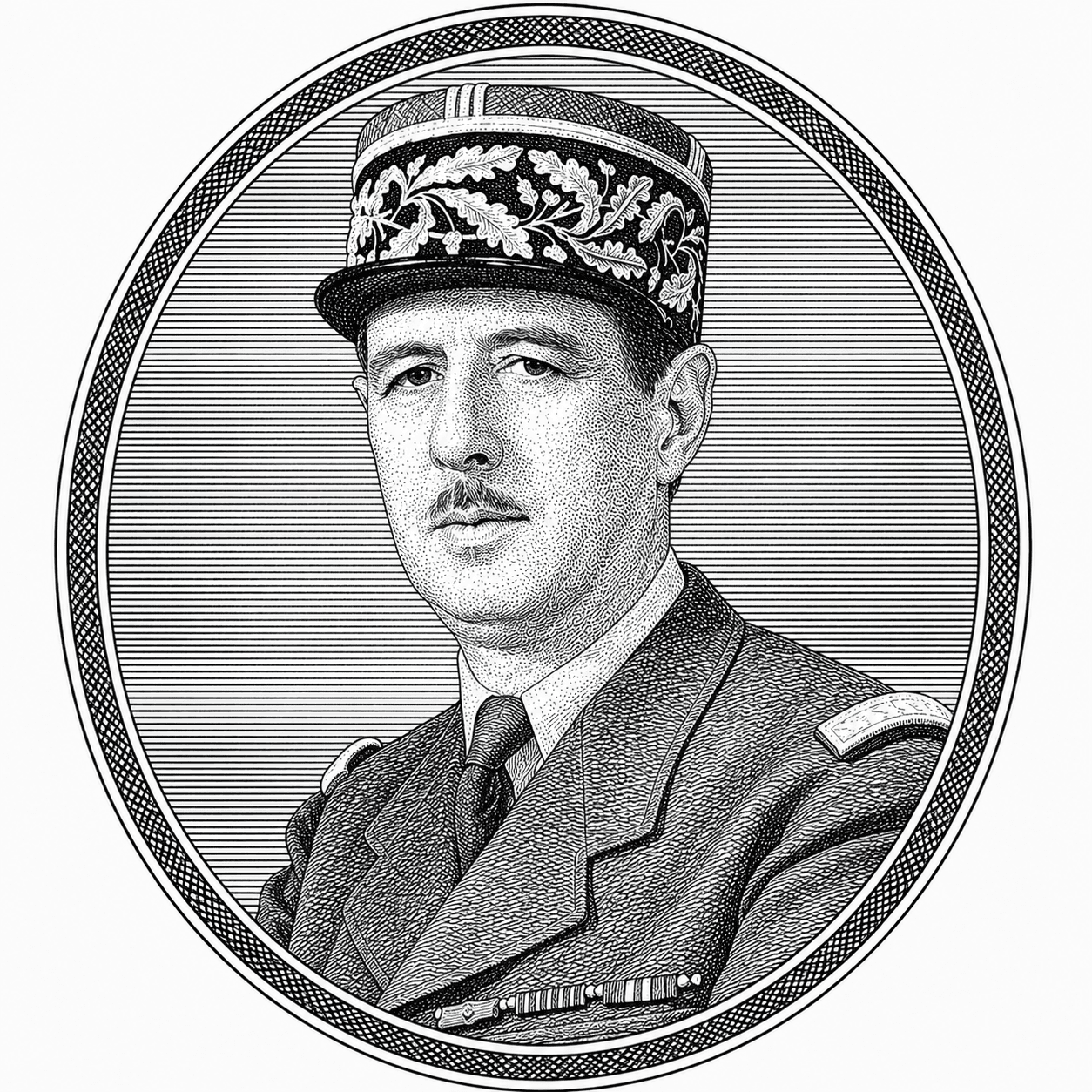
1890–1970
Charles de Gaulle, Pondicherry
President of France; ratified French India's transfer to India in 1962
He did not build French India, and barely engaged with it personally. But it was his government that finally signed the law ending three centuries of French rule, eight years after Pondicherry had already changed hands.
THE SIGNATURE THAT ENDED IT
Charles de Gaulle's role in the story of French India is administrative rather than personal, and he would probably have agreed with that description himself. By the time he returned to power in 1958 to found the Fifth Republic, French administration in Pondicherry had already ended: the de facto transfer to India had taken effect in 1954, under the Fourth Republic, four years before de Gaulle became President. What remained was a legal formality with an unusually long half-life.
The Treaty of Cession had been signed back in 1956, under Guy Mollet's government, but required parliamentary ratification to take legal effect, and French parliamentary attention for the rest of that decade was consumed almost entirely by the war in Algeria. The treaty sat waiting for six years. De Gaulle's government finally resolved the Algerian question with the Évian Accords in March 1962, and with that crisis cleared, the ratification law for French India, Loi n° 62-862 du 28 juillet 1962, passed that July. The de jure transfer took legal effect on 16 August 1962, the last formal act in a French presence that had begun with François Martin in 1674.
Unlike Algeria, French India's transfer generated almost no domestic controversy. The administrative handover was already eight years old, the population of the former settlements was broadly settled on the outcome, and there was no constituency in France with a reason to fight it. It passed through the National Assembly as one small item within a much larger wave of decolonisation, alongside the independence of France's African territories and the resolution in Algeria, all within the same few years of de Gaulle's presidency.
The more lasting legacy of his government for Pondicherry was cultural rather than legal. His Minister of Culture, André Malraux, met Jawaharlal Nehru in November 1958, and their conversation on the place of French culture in independent India shaped the framework under which institutions like the Institut Français de Pondichéry and the city's French lycée were allowed to continue operating after 1962, preserving Pondicherry's status as, in Nehru's own phrase, a window on French culture. De Gaulle did not make French India. He signed the paperwork that closed the file on a story whose decisive scenes had already been played out, under Louis XV and Dupleix two centuries earlier, and under Nehru and Edouard Goubert just a few years before his own signature made it final.

The Pondy App
Take this guide with you
Offline maps, street-level history, restaurant picks, and hotel guides: everything on this site, in your pocket.