
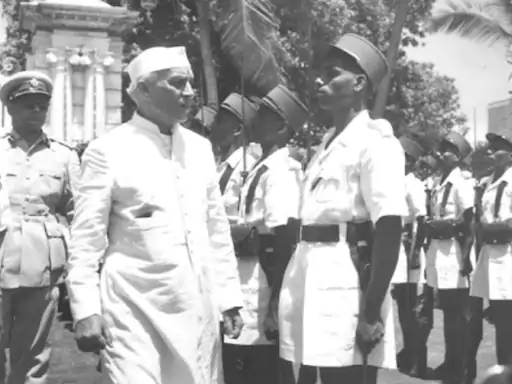
1954: The Handover
India became independent in 1947. Pondicherry did not. For seven more years, the tricolour flew over the French Quarter while the rest of the country remade itself. When the transfer finally came, it was orderly, and carefully incomplete.
India became independent on 15 August 1947. Pondicherry did not.
Two Indias
For seven years after the rest of India achieved independence from Britain, Pondicherry remained under the French tricolour. The situation was anomalous, and everyone knew it. French India, now reduced to five tiny enclaves across the subcontinent, was formally part of the French Republic. Its citizens were French nationals. Its law was the Code Civil. Its schools taught in French. Nehru's new government pressed diplomatically for a transfer; France, preoccupied with its own crises in Indochina and Algeria, moved slowly.
The political atmosphere inside the enclaves was charged. A movement for merger with India, the Mouvement pour la Libération de l'Inde Française, had been active since the mid-1940s. There were demonstrations, strikes, and a sustained campaign of civil disobedience modelled explicitly on the methods of the Indian National Congress. The Indian government closed its consulate in Pondicherry in 1954 after a particular escalation of tension. The French administration found itself governing territory that many of its own citizens wished to leave.
The decisive political shift came in March 1954 when Édouard Goubert, who had been the architect of the pro-French electoral position in 1948 and the leading local voice for remaining French, defected to the Indian side. His crossing removed the principal local political obstacle to the transfer. By October 1954, the Congrès de Kizhour, the deliberative assembly on the question of merger, voted 170 to 8 in favour. The mathematics of the situation had become impossible to deny.
The Transfer
On 1 November 1954, the de facto transfer took place. The French administration handed power to a pro-merger provisional government. The French flag came down; the Indian tricolour went up. French administrators departed. Indian officials arrived. The transfer was orderly, negotiated, and peaceful, governed by a 35-article accord that addressed administrative arrangements, the rights of French citizens, and the guarantee of French language rights under Article 28.
The formal legal transfer, the Treaty of Cession, was signed on 28 May 1956 and ratified by the French National Assembly in July 1962, with full legal effect from 16 August 1962. Pondicherry became, in international law, part of India. Its residents were offered a choice between French and Indian citizenship. A significant number chose French, and the French consulate that operates on the Rue de la Marine today is a direct descendant of that choice. Both dates are still marked each year: 16 August, De Jure Day, is the middle day of the three-day Fête de Pondichéry.
What Was Kept
What happened next is, by the logic of colonial history, surprising. The French institutions largely survived. The legal system retained elements of the Code Civil that persist in modified form to this day. The schools continued to teach in French. The Lycée Français, the Alliance Française, and the French consulate continued to function. The street names were not renamed: Dupleix, Suffren, Labourdonnais, Romain Rolland, all still there on their blue enamel plaques.
The explanation is partly practical: there were too many French institutions, too deeply embedded, to dismantle quickly. But it is also something more interesting: a recognition, on both sides, that what Pondicherry had accumulated over three centuries was worth preserving as itself. Nehru's government understood that a city with this particular history was not the same as any other Indian city, and that erasing what made it distinctive would be a loss rather than a gain.
Pondicherry became a Union Territory, reporting directly to Delhi rather than being absorbed into Tamil Nadu. This status, maintained to this day, is partly a legacy of the transfer negotiations: the French sought assurances that the character of the settlement would be protected, and those assurances were given.
The City That Resulted
The Pondicherry that exists today is the product of all of this. The Tamil quarter to the west of the canal has its own continuity: its temples, its markets, its languages, its rhythms, which no change of flag ever interrupted. The French quarter to the east is something unique: a South Indian city that also has the architecture, the street plan, and some of the cultural habits of provincial France, overlaid with the spiritual intensity that Sri Aurobindo and, after him, Mirra Alfassa, known as the Mother, and Auroville brought in the twentieth century.
The French who come today often have the disorienting sensation of recognition: the proportions of the buildings, the scale of the streets, the relationship between the sea and the promenade, something in the quality of the afternoon light that makes Puducherry the 'Window of France on India' as Nehru famously said. And yet the sounds and the smells and the faces are entirely Tamil, entirely South Indian. The city is not a museum of colonialism. It is a living place that has metabolised its history and made it its own.
That is perhaps the most interesting thing about Pondicherry. It absorbed the Romans and the Pallavas, the Cholas and the Mughals, the French and the British, the ashram and the commune. It remains recognisably itself. The sea that the Roman merchants sailed to reach it is the same sea you can see from the promenade today. The continuity is the city.
Frequently Asked Questions
Why is French culture so visible in Pondicherry?
Pondicherry was a French colony for nearly three centuries until it became part of India in the mid-20th century. This history is reflected in the town's architecture, street names, churches, cafés, educational institutions, and culinary traditions. White Town still preserves many colonial buildings and a distinctly European atmosphere. The French influence blends with Tamil culture, creating a unique identity found nowhere else in India. Institutions such as the Lycée Français and the Alliance Française still operate today.

The Pondy App
Take this guide with you
Offline maps, street-level history, restaurant picks, and hotel guides: everything on this site, in your pocket.