
French Institution
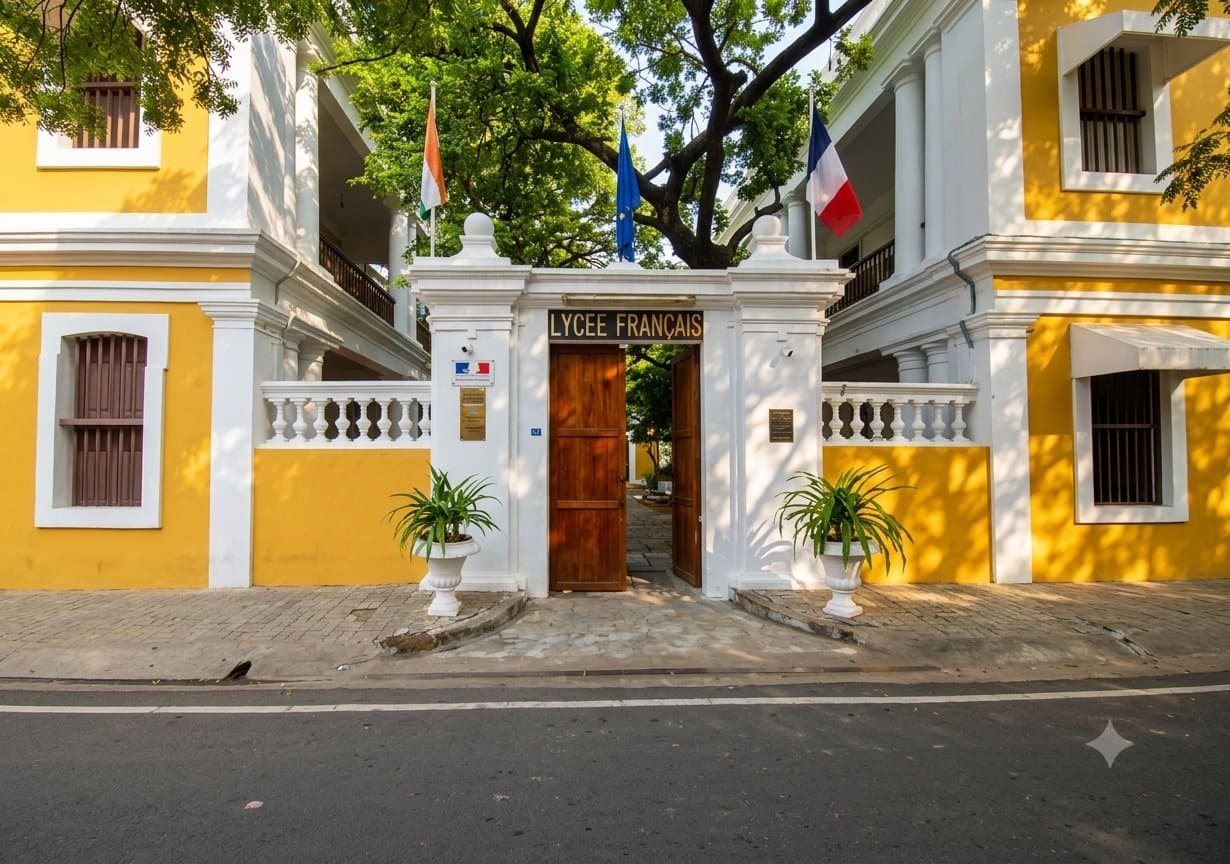
Lycée Français International, Pondicherry
In autumn 1826 the same governor who opened the Pensionnat de Jeunes Filles also founded a college for boys. Nearly two hundred years later, both institutions are still open. The Lycée is the older of the two by a few weeks.
On 26 October 1826, Governor Eugène Desbassayns de Richemont signed the founding decree for a college for boys in Pondicherry. He called it the Collège Royal de Pondichéry. It is still open today, nearly two hundred years later, as the Lycée Français International de Pondichéry. Its bicentenary falls in 2026, making it one of the oldest continuously operating French overseas schools in the world.
On the same day, the same governor signed the founding decree for the Pensionnat de Jeunes Filles. Two institutions, one year, one administrator. Between them they defined the structure of French colonial education in India for the century that followed.
The Colonial College
The Collège Royal was founded to educate the children of the French colonial population: in the language of the time, the "white class," meaning the sons of administrators, merchants, and the métis families of the French quarter. Its mission was precise: to provide elite instruction in French, to train the administrative intermediaries that French India required, and to produce a class of young men who could function inside both the colonial system and the world of French academic culture.
The curriculum was classical French in orientation, literature, mathematics, philosophy at its core, but with an unusual addition that distinguished this school from many of its counterparts elsewhere in the French empire. Tamil and Hindustani were introduced early into the programme. This was a practical acknowledgement that the school's graduates would spend their lives in India, and that a purely European education would not equip them for the place they actually inhabited.
Governance Shifts
Through the first century, the institution moved between secular and religious administration several times. It began under secular French colonial governance, was entrusted to the Missions Étrangères de Paris, the Catholic missionary body that ran several of the colony's educational institutions, and returned to secular state control depending on the political moment in France. The alternation between Church and state was not unusual for French colonial schools of this period: it reflected the shifting balance between republican laïcité and Catholic influence that dominated French politics from the Revolution through the Third Republic.
Each governance transition left its mark on the curriculum and the student body. When the school reopened under fully secular Republic control in 1900, after the anticlerical reforms that reshaped French public education, it became more explicitly merit-based and opened gradually to a wider range of Indian students. Access was not equal, but it was expanding.
From Colonial Tool to Bridge Institution
After the Second World War, the geopolitical ground shifted dramatically. India became independent in 1947. French India did not, but everyone understood that the transfer was coming. In this period the school became something more deliberately calibrated: a symbol of French soft power, a bridge between two political worlds that were about to separate formally.
It educated both French citizens and Indian elites through the years of transition from 1947 to 1954. It prepared students for a future in which the flag over the building had not yet been settled. When the de facto transfer came in November 1954, the school was one of the institutions that both sides had reasons to preserve.
The AEFE and the Baccalauréat
After 1954 the Lycée retained its French curriculum under bilateral agreements between France and India. It was brought into the AEFE, the Agence pour l'Enseignement Français à l'Étranger, the global network that governs French schools outside France. This ensured full curriculum continuity and diplomas equivalent to those awarded anywhere in France.
The school is one of fewer than ten institutions in India authorised to conduct the full French Baccalauréat, the national secondary school leaving examination that is the gateway to French and European universities. Because of the local academic calendar, students in Pondicherry typically sit the Bac before their counterparts in mainland France.
The Modern School
Today the Lycée Français International de Pondichéry follows the French national curriculum from primary through the final "Terminale" year, in strict alignment with the French Ministry of Education. French is the primary language of instruction. English is a strong second. Tamil is offered as a local language. German and Spanish are optional. Students who complete the programme receive the French Baccalauréat and an international admissions profile that opens universities across France and Europe.
Three Regimes, One School
The Lycée Français International de Pondichéry has operated under French monarchy and empire, French republic, and Indian sovereignty without closing. It has survived every political transition this city has undergone since 1826 and has educated generations of students who went on to French universities, Indian professional careers, and lives on both sides of the relationship the school was built to serve.
That continuity across three regimes, across colonial and postcolonial, across French and Indian sovereignty, is itself the argument for what this school is and what it represents in Pondicherry.

The Pondy App
Take this guide with you
Offline maps, street-level history, restaurant picks, and hotel guides: everything on this site, in your pocket.