
French Institution
Consulat Général de France, Pondicherry
France is one of the few countries that maintains a Consulate General in a city of Pondicherry's size. The reason is specific: after 1962, thousands of Pondicherrians chose French citizenship and needed a state to answer to.
The Consulate General of France in Pondicherry is not simply another diplomatic mission. It is the direct institutional successor of nearly three centuries of French administration in India: one of the very few diplomatic representations in the world that evolved from a former colonial government into a modern consular office without ever closing, without ever relocating, and without ever breaking the thread of institutional continuity that connects it to François Martin's first settlement in 1674.
From Colonial Capital to Consulate
France established itself in Pondicherry in 1674, when Martin founded the settlement that would become the capital of French India. For nearly three centuries, the Governor of Pondicherry exercised authority over the five settlements: Pondicherry, Karikal, Mahé, Yanam, and Chandernagore. Civil administration, justice, taxation, education, public works, and diplomatic relations with neighbouring kingdoms and British India all passed through this office.
When the de facto transfer of French India to India took place on 1 November 1954, the colonial administration ended. Diplomatic relations did not. France transformed its former administrative apparatus into the Consulate General of France, which became the official representative of the French Republic in the former settlements following the Treaty of Cession, signed in 1956 and fully ratified in 1962. The flag changed. The institution remained.
Why France Stays
Most countries establish consulates where there is a significant national community or important cultural and economic interests. Pondicherry satisfies all of these at once.
Following the transfer, thousands of residents chose French nationality over Indian citizenship. Descendants of renonçant families, Franco-Tamil veterans, civil servants and their children: a large and rooted community of French nationals chose to remain in Pondicherry rather than emigrate. They needed passports, civil registration, electoral rolls, notarial services, pension administration, and a French state that could see them. The Consulate General was that state.
Today it also serves as the coordinating centre for France's institutional presence across southern India: the Alliance Française de Pondichéry, the Lycée Français International, the EFEO, and the broader network of French cultural and research activity in the region. Its jurisdiction extends beyond Pondicherry to cover Tamil Nadu through its office in Chennai.
The Community It Serves
What makes this consulate unlike most others is the intimacy of its relationship with the city. For many Pondicherry families, births, marriages, passports, and deaths have been processed by French authorities across several generations, creating a continuity between the colonial and post-colonial periods that is almost without equivalent anywhere in Asia.
The community it serves includes French citizens born in Puducherry, descendants of renonçant families who retained French nationality at the 1963 option, former French civil servants and their families, descendants of Franco-Tamil soldiers who served in the Troupes coloniales across the world wars and the Indochina and Algerian conflicts, students pursuing French education, and researchers attached to French institutions. For many of these families, the Consulate is not a foreign diplomatic office. It is an institution woven into their family history.
Bastille Day and the War Memorial
Each year on 14 July, the Consulate organises the Bastille Day ceremonies that remain a genuine civic occasion in Pondicherry. Wreaths are laid at the French War Memorial on Goubert Avenue, attended by French officials, veterans' families, and members of the Franco-Tamil community. These ceremonies are not pageantry. They reflect a shared history that extends beyond diplomacy into memory and identity, connecting the city to the soldiers it sent to the Western Front, to North Africa, to Indochina, and to the families those soldiers left behind.
The Building
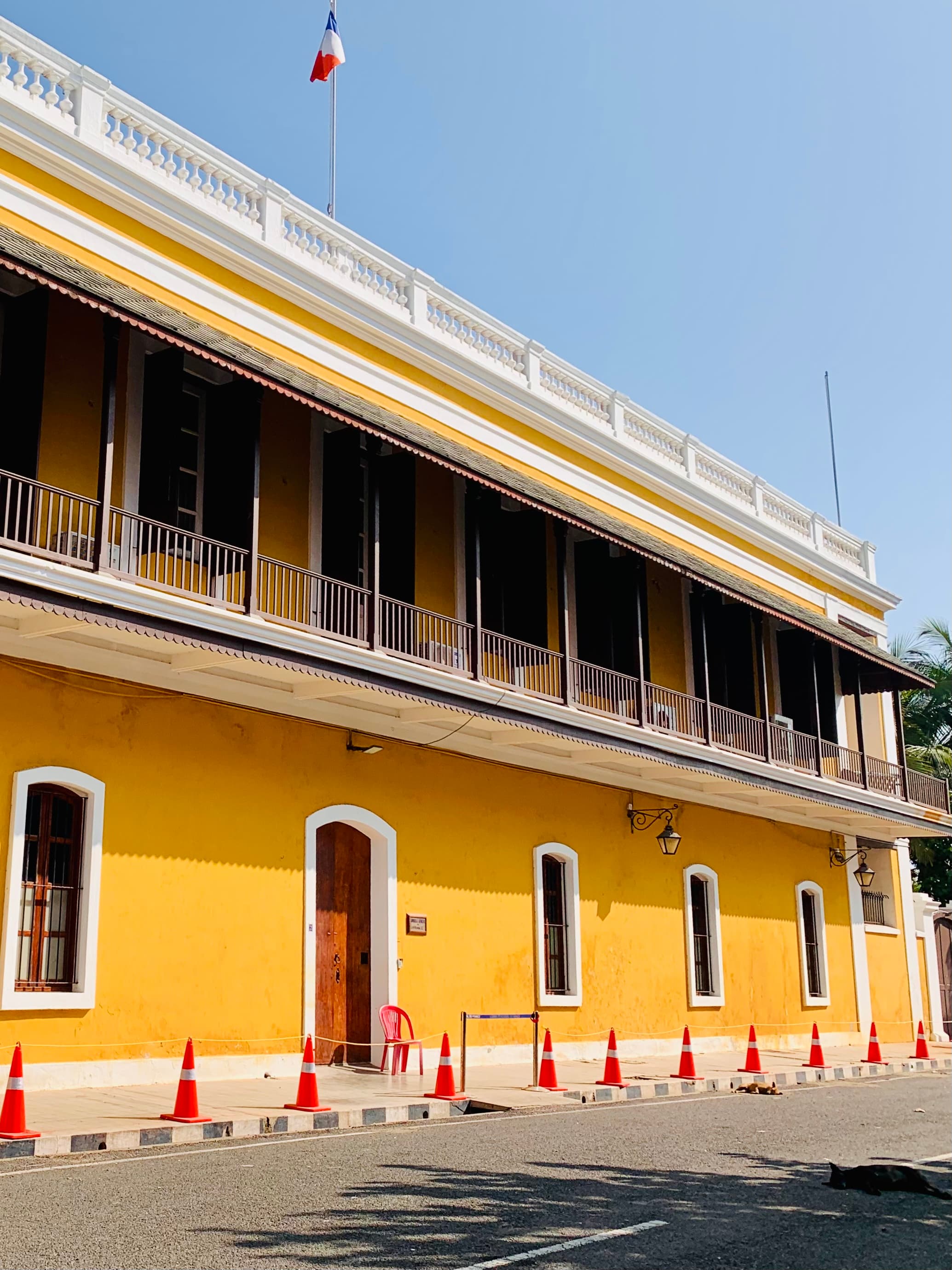
The Consulate occupies one of White Town's finest colonial buildings on the Rue de la Marine, dating back more than two centuries. Its architecture is the Franco-Tamil blend characteristic of the French quarter: thick masonry walls, spacious verandas, shaded courtyards, high ceilings adapted to the tropical climate. In recent years the building has also become a model of heritage conservation, incorporating rooftop solar power and modern sustainability measures while preserving its historic fabric.
It is the oldest continuously occupied site of French official presence in India. What happens inside has changed entirely since Martin's day. The walls are the same.

The Pondy App
Take this guide with you
Offline maps, street-level history, restaurant picks, and hotel guides: everything on this site, in your pocket.