
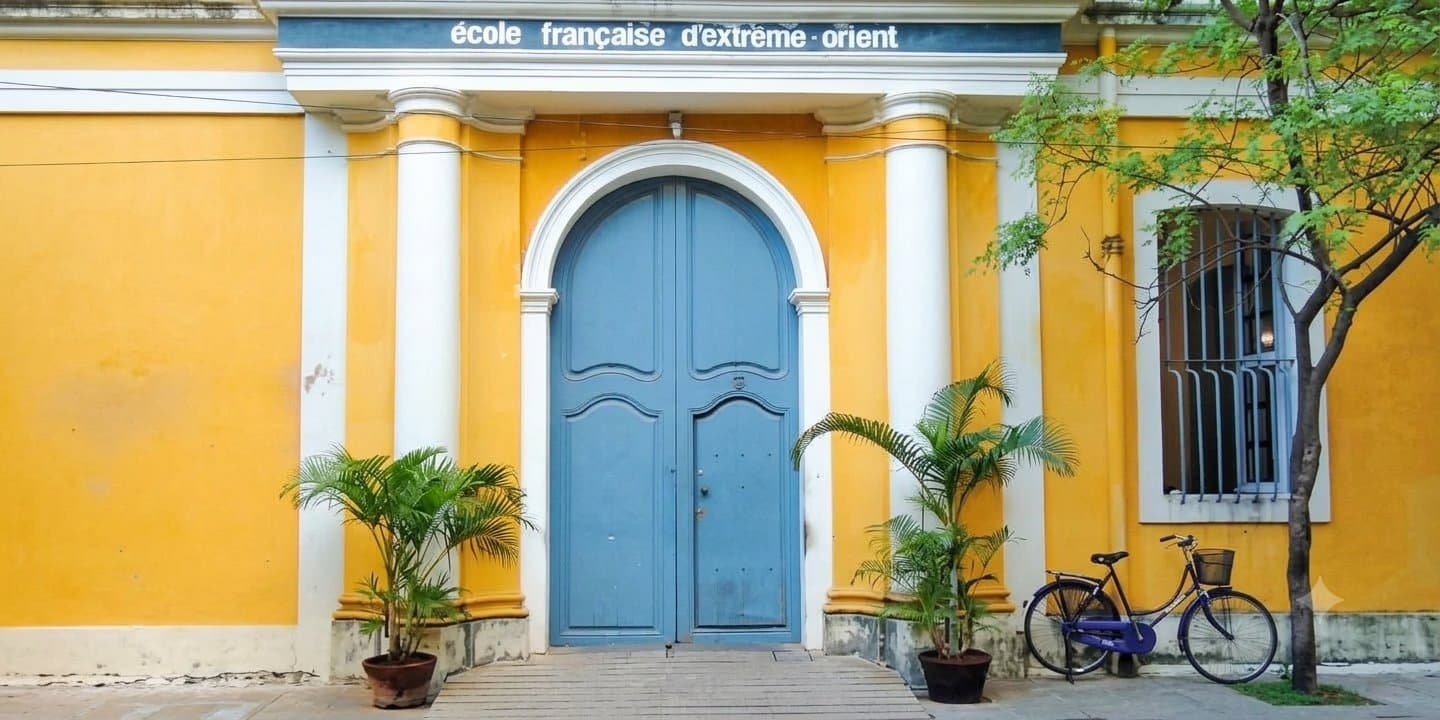
French Institution
EFEO Pondicherry Centre
Founded in Saigon in 1900 to study the civilisations of Asia, the EFEO relocated its scholars and collections to Pondicherry as French Indochina collapsed. What it has built here since is one of the world's most rigorous centres for understanding Indian civilisation in its full historical depth.
The École française d'Extrême-Orient was founded in 1900 in Saigon, at the height of French colonial confidence in Southeast Asia. Its mandate was precise and deliberately non-administrative: not to govern, not to train colonial officials, but to study the civilisations of Asia through rigorous humanities research. History, archaeology, epigraphy, Sanskrit and Tamil philology, anthropology, religious studies, historical geography, material culture: the full scope of what it means to understand a civilisation rather than merely occupy it. EFEO is not a teaching university. It is a high-level international research institution, and it has been pursuing that mandate for over a century.
From Saigon to Pondicherry
The EFEO built its reputation over half a century in the temples and manuscripts of Indochina. When the French position in Southeast Asia collapsed in the 1950s, the centre relocated to Pondicherry, where French jurisdiction still held. Under Jean Filliozat, one of the twentieth century's foremost authorities on Sanskrit, Indian philosophy, and the history of Ayurveda, the Pondicherry centre was established from 1955 as the EFEO's primary anchor in South Asia. Filliozat set the intellectual framework: this would be a place where India was studied in its full historical and living depth, not as a specimen of colonial interest but as a major civilisation deserving the most rigorous scholarly attention.
Why Pondicherry
What Pondicherry offered was a convergence of sources that few places in the world could match. Thousands of palm-leaf manuscripts in Sanskrit and Tamil, including rare Shaiva Siddhanta philosophical texts and regional religious literature that existed nowhere else. A dense concentration of South Indian temple inscriptions from the Chola, Pallava, and Vijayanagara periods, essential for reconstructing the political, economic, and cultural history of the subcontinent. Three centuries of preserved French administrative archives, giving scholars access to colonial cartographic and documentary sources that illuminated South Indian territorial organisation in ways no purely Indian archive could. And the living continuity of temple ritual and religious practice, which allowed scholars to study India as a continuous civilisation: historical and living at the same time.
The Textual Tradition
The first major intellectual tradition EFEO Pondicherry built is one of textual and philosophical scholarship. Filliozat's foundation was carried forward by a succession of scholars whose work reshaped Indology globally.
François Gros became one of the leading Tamil scholars in Europe, his work on classical Tamil literature recasting how the Sangam corpus was read and understood outside India. Dominic Goodall has become one of the foremost living authorities on Shaiva texts and the Shaiva Siddhanta philosophical system that developed in Tamil Nadu and spread across Southeast Asia and beyond: his critical editions of Sanskrit manuscripts are used by scholars worldwide. Éva Wilden has spent decades illuminating how classical Tamil poetry was transmitted through manuscript traditions, what was copied, what was changed, and what that reveals about how a literary culture understood itself across centuries. Arlo Griffiths works at the intersection of epigraphy and the cultural connections between India and Southeast Asia, maintaining the EFEO's original Indochina-era awareness that Indian civilisation does not stop at the subcontinent's shores.
Collectively this tradition has been essential for three things: the reconstruction of South Indian political history through inscriptions; the preservation of Sanskrit philosophical systems that exist only in fragile manuscript form; and the globalisation of classical Tamil literary scholarship beyond the boundaries of Tamil Nadu itself.
Jean Deloche and the Spatial Turn
The second major intellectual tradition is the more unexpected of the two, and it belongs almost entirely to one man. Jean Deloche, born in 1929 and a presence in Pondicherry from the 1960s until near his death in 2019, who directed the centre from 1992 to 1994, fundamentally expanded what the discipline could ask.
Deloche demonstrated that Indian history could be reconstructed not only through texts but through the physical infrastructure of the subcontinent. Roads and their routing logic. River crossings and navigation systems. Port infrastructure along the Coromandel and Malabar coasts. The fortification systems of South India, including his monumental documentation of the great fort complex at Gingee. The territorial organisation of kingdoms as readable from Dutch and French cartographic sources that colonial administrators had produced without understanding their scholarly value.
He showed that bridges, roads, forts, and spatial networks are historical documents as legible as inscriptions, if you know how to read them. This transformed EFEO Pondicherry into a centre not only for textual and philological scholarship but for historical geography and material civilisation studies in the fullest sense.
The Living Centre
The library on the Dumas Street campus holds thousands of volumes on Sanskrit, Tamil, and South and Southeast Asian languages, alongside rubbings of stone inscriptions, palm-leaf manuscripts, and photographic archives accumulated over more than a century of fieldwork. For certain areas of Indology and epigraphy, it is irreplaceable. Researchers arrive from France, Europe, Japan, and North America specifically to use it.
The centre continues to conduct field research across South India, publish critical scholarly editions of manuscripts and inscriptions, and collaborate with Indian universities and institutions. It remains one of the most respected global centres for South Asian studies.
The EFEO maintains establishments across Asia. The Pondicherry centre is arguably the most important: the place where the study of Indian civilisation, in its full historical, textual, spatial, and material depth, has been pursued with the greatest sustained seriousness, and where two complementary ways of reading India, through its texts and through its landscapes, have been developed side by side for seventy years.

The Pondy App
Take this guide with you
Offline maps, street-level history, restaurant picks, and hotel guides: everything on this site, in your pocket.