
French Institution
Petit Séminaire, Pondicherry
Started to train clergy in the last decade of the eighteenth century, it has been teaching boys without interruption ever since. Every political transition the city has experienced, it survived.
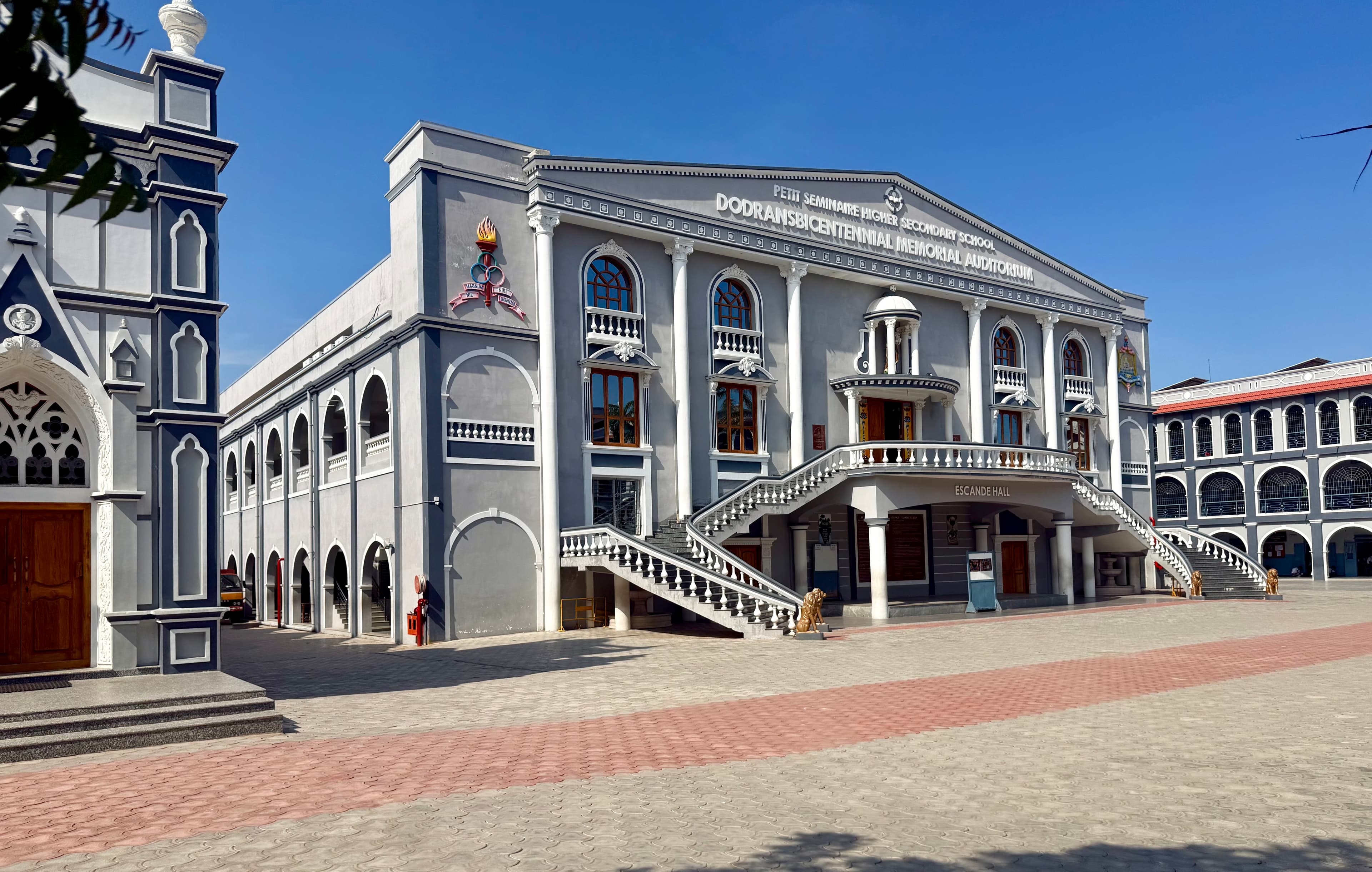
There is a school in the heart of Pondicherry that has been teaching boys since 1792. It has changed names, changed languages, changed systems of examination, and changed its relationship to both the Church and the state. It has never closed. What you see when you stand in front of it today is the physical expression of every political and religious transition this city has lived through, accumulated in stone over two and a half centuries.
The Seminary
Petit Séminaire was founded in 1792 under French Catholic missionary influence. Its original mandate was precise: to train seminarians as candidates for the clergy, to educate local Catholic youth, and, over time, to serve a broader student population. It was a seminary in form but already something more in ambition. The Church in Pondicherry understood that it could not sustain itself in India purely on imported priests. It needed to produce its own, and to do that it needed an institution.
By the early nineteenth century the school had already begun to outgrow its original purpose. The training of clergy remained central, but the walls had opened enough to admit students who had no intention of taking holy orders. The dual identity, part seminary, part college, was already established before the buildings themselves had reached their final form.
The Buildings
In 1844 the institution was formally consolidated into a structured school complex. The main buildings were completed and blessed on 19 March 1846, giving the school the physical presence it largely retains today. These were substantial French colonial structures: high ceilings, shaded corridors, the proportions of a serious institution rather than a temporary arrangement. Students today walk the same stone corridors that were laid down in the reign of Louis-Philippe, under a French colonial administration that still imagined it was building for permanence.
Opening the Doors
The first major transformation came in 1873, when the seminary became a fully public college. The restriction to clerical candidates was lifted. Enrollment expanded to include local populations beyond the narrow circle of Catholic families who had been the school's original constituency. It was no longer, in any meaningful sense, a seminary. It was a school.
In 1904 an English section was introduced, initially covering three standards. This was the first formal concession to a world in which English was becoming the language of advancement in India, even inside the boundaries of French Pondicherry. French remained the primary medium, but the institution had registered which way the wind was blowing.
The Academic Mainstream
The early decades of the twentieth century brought a sustained effort to integrate Petit Séminaire into the Indian academic mainstream without abandoning its French character. By 1932 the school had been upgraded to matriculation level and affiliated with Madras University. In 1934 the first batch of students sat for the matriculation examinations and passed successfully. The school had arrived in the modern Indian system.
This was a genuinely difficult balancing act. The curriculum was still substantially French in orientation. The language of instruction was still primarily French. But the qualifications it offered now had to be legible to Indian universities and employers, which meant Madras University affiliation, which meant English-language examinations, which meant a bilingual institution navigating between two systems simultaneously.
The Political Transition
After the de facto transfer of Pondicherry to India in 1954, the pressures on French-medium education intensified rapidly. Demand for English instruction increased across the city. The French Baccalaureate was discontinued in 1960, six years after the transfer. French settled into its current role as a language option, one of several that students could choose, rather than the medium through which everything else was taught.
This was not a sudden collapse but a managed withdrawal: the school adapting to political reality without sacrificing institutional continuity. The Archdiocese of Pondicherry-Cuddalore, which had managed the institution since its founding, ensured the transition was orderly.
The Modern School
In 1978 the school adopted the 10+2 higher secondary structure that organises Indian secondary education today, becoming Petit Séminaire Higher Secondary School in its current form. What had begun as a seminary of perhaps a hundred students had become a large institution serving thousands, with science, commerce, and computer science streams alongside Tamil, Hindi, and French as language options.
The Living Archive
What distinguishes Petit Séminaire from most Indian schools is not its curriculum, which is now entirely conventional, but its continuity. The Archdiocese has managed this institution across every political transition the city has experienced: French colonial rule, the British occupation of 1761, the restoration of French authority, Indian independence, the transfer of 1954, and the six decades of Indian administration since. The school was here through all of it, on the same ground, teaching the same boys of this city.
Its alumni include Prapanchan, the Tamil writer S. Vaidyalingam, who received the Sahitya Akademi award, along with generations of clergy, academics, civil servants, and professionals who carry some trace of its particular inheritance. A French Catholic institution that became, without ever quite intending to, a thoroughly Indian one.

The Pondy App
Take this guide with you
Offline maps, street-level history, restaurant picks, and hotel guides: everything on this site, in your pocket.