
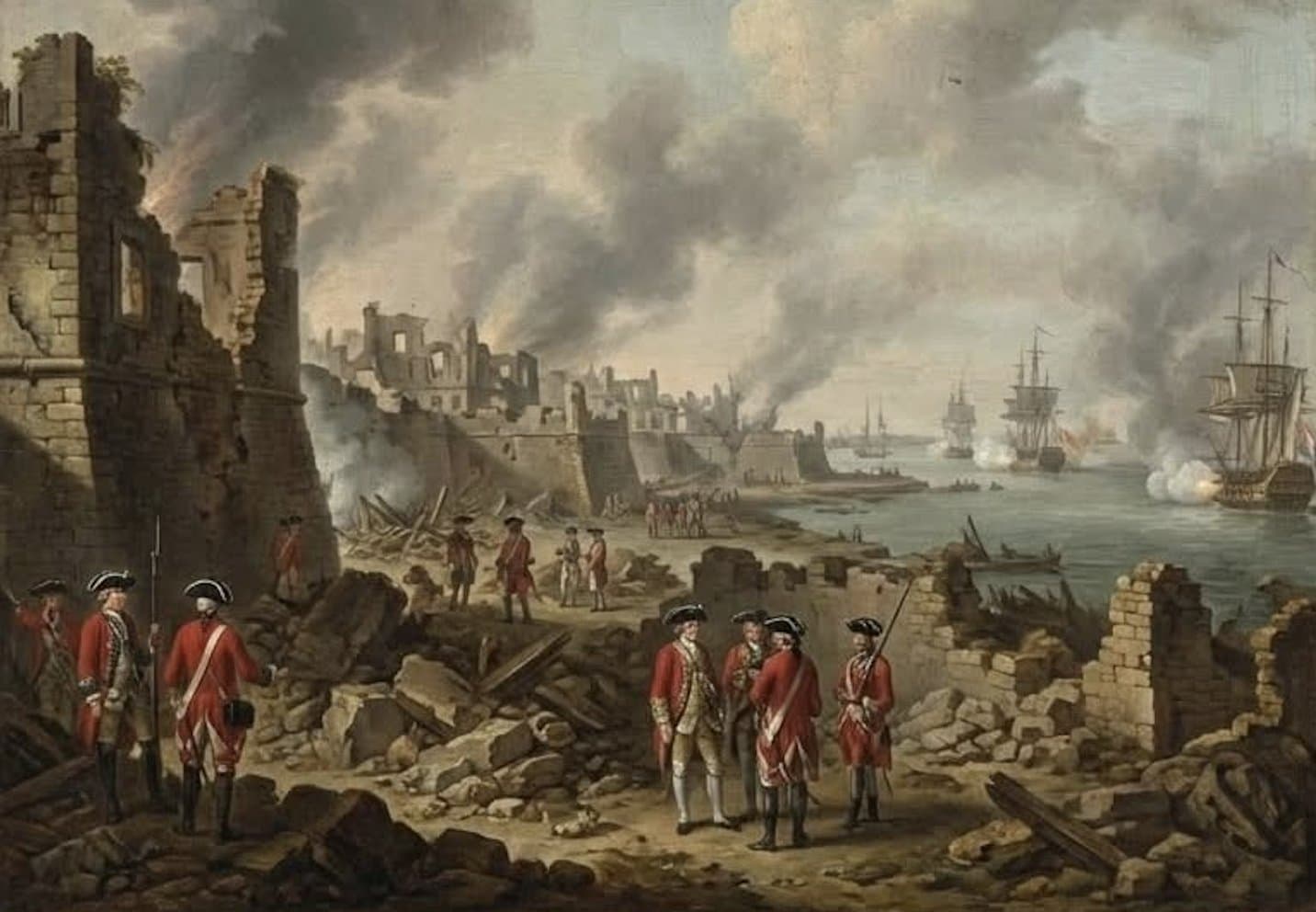
The Fallen City
In 1761 the British captured Pondicherry and systematically demolished it. What the French recovered eight years later was a field of rubble. The city you see today was built on that foundation, stone by patient stone.
In 1758, with Dupleix's grand project already unravelling, France sent a new commander to save its Indian position. Thomas Arthur, Count of Lally, arrived at Pondicherry that spring full of energy and quickly made enemies of everyone around him.
Lally
Lally was Irish-French, the son of an Irish Jacobite who had served Louis XIV. He had distinguished himself in European campaigns and was appointed by the King himself to restore French fortunes in India. He was also, by all accounts, extraordinarily difficult: contemptuous of the civilian officials of the Compagnie, dismissive of the officers who had been fighting in India for years, and convinced that the failures of French India were the result of corruption and timidity rather than structural problems.
He arrived to find the French position already weakened by four years of reversal since Dupleix's recall. Bussy's Deccan protectorate was still nominally intact, but the Carnatic was largely lost. Lally chose to recall Bussy from Hyderabad in order to concentrate force in the south, a decision that immediately unravelled everything Bussy had built. The alliance with the Nizam collapsed within months.
His one significant success was the Siege of Madras in 1758 and 1759, which came tantalizingly close to capturing the British capital of the Coromandel Coast. A British naval squadron arrived to resupply the garrison. Lally, lacking equivalent naval support, was forced to withdraw.
Wandiwash
The decisive engagement came on 22 January 1760, at the inland town of Wandiwash. Sir Eyre Coote, a methodical British general who understood the new military reality in India, met Lally's force in open battle and defeated it. Bussy, present in the French ranks, was captured. The French field army was broken. Pondicherry was now isolated, surrounded on three sides by British forces and on the fourth by the sea.
The Siege
Eyre Coote followed and invested the city from the landward side while the British navy blockaded the harbour. The siege began in August 1760. Pondicherry at this moment was not a village or a small trading post: at the peak of the Dupleix era it had housed between 80,000 and 100,000 people. Even reduced by the years of reversal, it was a substantial city protected by Fort Louis, completed by Martin in 1702 and improved since, with walls three metres thick in places and brick-lined magazines designed to absorb artillery fire. Lally organised the defence with considerable energy. The garrison, though reduced, was experienced. But the city had no means of resupply once the blockade was complete, and its population was large relative to its food stocks.
British engineers advanced their trenches systematically through the autumn of 1760. Food shortages became critical by December. By January 1761 the situation was unsustainable. On 16 January 1761, Lally surrendered. The terms were the honours of war: the garrison was allowed to march out with their arms. The siege had lasted five months.
The Demolition
What happened next was deliberate policy, strategic rather than merely punitive. The Madras Council reasoned that Pondicherry as a fortified city capable of sheltering a French army and fleet had been the direct cause of thirty years of Carnatic warfare. If France were to recover it by treaty, as seemed likely given the precedents of earlier wars, the British were determined it should not recover a functioning military base. A tolerable commercial inconvenience was acceptable; a revived rival capital was not.
The demolition was comprehensive. Fort Louis was the first target: its bastions were mined and blown up with gunpowder, its walls breached and pushed down, its magazines opened and stripped. Contemporary accounts record the detonations as audible for miles, the smoke hanging over the city for days. The Government Palace, which had been the site of Dupleix's audiences with Indian princes and ambassadors and whose records were either carried off to Madras or lost, was pulled down. The churches, the warehouses along the waterfront, the colonnaded townhouses of Rue de la Marine and Rue Dumas, the hospital, the barracks: all demolished. French officers who had negotiated honourable surrender terms watched from outside the walls as works some of them had themselves built were systematically destroyed.
The Black Town to the west of the canal suffered less comprehensively, but was not spared. One building survived intact in the White Town: the house of Ananda Ranga Pillai, built of solid laterite and teak, sealed against the street behind its internal courtyards. Pillai himself died on 25 January 1761, nine days after the surrender, without recording in his diary the demolition he had feared. His house stands today. The street grid and the canal also survived because they were features of the landscape rather than of the built fabric: even when every building on every street had been pulled down, the plan of the city remained legible in the ground.
Lally was sent back to France, imprisoned in the Bastille, tried for treason, and executed in 1766. Voltaire, outraged by the injustice of it, campaigned for years until Lally's conviction was posthumously overturned in 1778. The street in the French Quarter named for Lally-Tollendal carries the name of a man who was formally cleared of dishonour only long after his death.
The Treaty and Its Condition
The Treaty of Paris in February 1763 returned Pondicherry to France, but under a condition without precedent in earlier colonial treaties: France was prohibited from erecting fortifications or maintaining military forces beyond small police detachments. This provision, secured by British diplomacy, transformed Pondicherry from a potential military base into a permanently disarmed commercial enclave. The physical demolition and the treaty clause together achieved what the British wanted: a Pondicherry that could trade but could never again threaten Madras.
When the first French governor of the restored city, Jean Law de Lauriston, stepped ashore in 1765, he arrived in a field of rubble. What he found was silted canals, overgrown foundations, and a remnant community camped in the Black Town. What he had to work with was the street grid, the surviving foundations of demolished buildings, and their cut stone and brick, now available as salvage material for reconstruction.
The Rebuilding
Law de Lauriston rebuilt with remarkable speed. Within five months of his arrival, according to contemporary accounts, some 200 European houses and 2,000 Tamil houses had been erected on the old grid. These were simpler structures than the demolished originals, but they established occupation and restored the basic functions of urban life. The Papier terrier survey of 1777, the land register compiled a decade later, shows the White Town substantially re-settled: two-storey houses of the characteristic Franco-Pondicherrian type, arcaded ground floors, French windows, internal courtyards, the architectural language that still characterises the heritage streetscape today.
The rebuilding was interrupted twice more. Britain occupied Pondicherry again during the American Revolutionary War from 1778 to 1783, causing further damage. A third British occupation from 1793 to 1816, driven by the Revolutionary and Napoleonic Wars, caused additional destruction. Only after the Treaty of Paris of December 1816 did Pondicherry pass into stable French possession for the remainder of the colonial period. The city you see today is the product of all three rebuilding cycles, constructed literally on top of the demolition rubble: archaeological investigation of White Town plots has repeatedly encountered the cut laterite blocks and iron fittings of the demolished Fort Louis reused as foundation fill in later construction.
French India shrank to five small enclaves across the subcontinent: Pondicherry, Karikal, Mahé on the Malabar Coast, Yanam in what is now Andhra Pradesh, and Chandernagore in Bengal. The combined population of all five was perhaps 200,000 people, surrounded on every side by the vast territories of the British Raj. Pondicherry was an anomaly, a place where French law applied and the language of administration was French, a small sovereign curiosity on a coast where everything else answered to Calcutta.
The Arrival of Aurobindo
In 1910, a Bengali philosopher, poet, and former revolutionary named Aurobindo Ghosh crossed the border from British India into French Pondicherry. He had been under British surveillance as a political agitator, and French jurisdiction offered a different set of laws. He had no intention of leaving.
He stayed for the rest of his life, founding the ashram that still bears his name on the seafront, developing the philosophy he called Integral Yoga, and drawing followers from across the world. His arrival transformed what Pondicherry meant. The city that had been, for a decade in the 1740s, the capital of a near-empire, and for a century after that a modest and somewhat melancholy colonial backwater, began to become something else: a place of serious spiritual inquiry, with an international community gathered around a teaching that had nothing to do with trade routes or territorial sovereignty.
The city he arrived in was quiet and conscious of its diminished status. Its streets still carried the names of French governors, admirals, and battles. Its canal still divided the Tamil quarter from the French. But the energy that had made it a capital was long gone. What remained was the grid, the stones, the sea wall, and a particular quality of light in the late afternoon that has nothing to do with politics and everything to do with where you are on the earth.

The Pondy App
Take this guide with you
Offline maps, street-level history, restaurant picks, and hotel guides: everything on this site, in your pocket.