
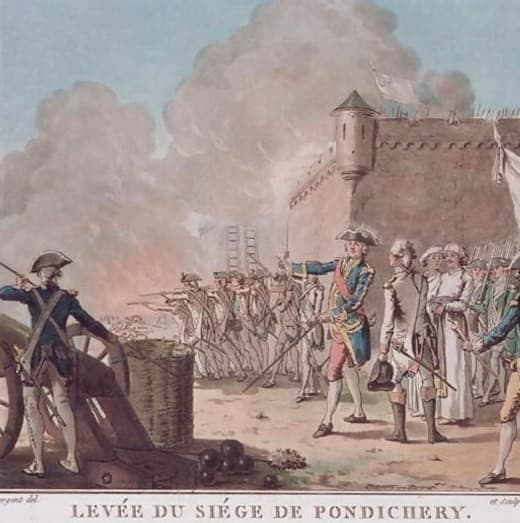
Dupleix's Gamble
In 1742 a new governor arrived in Pondicherry with an audacious idea: that France could rule the Deccan not through trade, but through political genius. For a decade, he was almost right.
On the morning of 15 January 1742, Joseph François Dupleix stepped ashore at Pondicherry to the thunder of twenty-one cannon salutes. He had already decided what kind of governor he intended to be. The Compagnie des Indes had sent him to run a trading post. He intended to build an empire.
The Making of a Method
Dupleix was not the first Frenchman to govern Pondicherry, but he was the first to understand the political moment with any clarity. The Mughal empire that had dominated the subcontinent for two centuries was fracturing along every seam. The great subhadars and nawabs of the south were fighting succession battles that no amount of imperial authority in Delhi could resolve. Into each of these contests came rival claimants, rival armies, and the desperate need for cash and trained soldiers.
Dupleix saw the opportunity before anyone else in a European coat did. Whoever supplied cannon and European-trained infantry to the right pretender at the right moment could claim, as his fee, territorial grants and revenue rights worth far more than any trading profit the Compagnie had ever imagined. This was not trade. This was politics. And politics, in the Indian understanding of the word, meant sovereignty.
The Architect of Ceremony
He understood that politics in the Mughal world was also theatre. To be taken seriously as a sovereign actor, he had to look like one.
An observer wrote in 1746: "When he marches in ceremony, he is preceded by more than a hundred troopers and three elephants, upon which his flags are carried, and his coach is followed by a crowd of horsemen and jesters." This was not vanity. It was a calculated signal, broadcast in a visual language every Indian ruler would read correctly. The French governor was not a merchant seeking favours. He was a power among powers, entitled to negotiate as an equal.
His indispensable broker was Ananda Ranga Pillai, a Tamil merchant whose private diaries are the most vivid account we have of this period. Pillai moved constantly between the French residence and the courts of Indian rulers, carrying intelligence, gifts, and the careful phrase at the right moment: the man who made the whole enterprise legible to itself.
The Deccan Pivot
The decisive moment came in 1749, when succession disputes ignited simultaneously in Hyderabad and the Carnatic. Dupleix backed two pretenders: Muzaffar Jang for the Hyderabad throne, Chanda Sahib for the Carnatic nawabship. A joint Franco-Indian force swept the field. The Nawab of the Carnatic was killed in battle. The new Nizam came to Pondicherry in person to acknowledge his patron.
The reward was staggering. By Mughal imperial grant, Dupleix was formally appointed Nawab and Governor of all southern India from the Krishna River to Cape Comorin. Pondicherry had become, in constitutional terms, the capital of the Deccan. His lieutenant Charles de Bussy rode north to construct a French protectorate across the entire plateau, from Aurangabad to the Orissa frontier.
For two years, it held. France was the dominant European power in India: not by seapower or by trade, but by political intelligence, ceremony, and the willingness to commit to Indian politics on Indian terms.
The British Counterstroke
The instrument of French reversal was a former bookkeeper named Robert Clive. Where Dupleix had built coalitions through ceremony and subsidy, Clive moved fast, struck hard, and chose his moments with the instinct of a man who knew his opponent's hand.
The fall came at Srirangam in June 1752. The French commander Law de Lauriston, encircled on an island in the Kaveri river, surrendered his force. Chanda Sahib was taken prisoner by a rival's men and beheaded the same afternoon. The protectorate in the Carnatic was gone.
Dupleix continued fighting, now financing the campaigns from his own personal fortune. He wrote to Paris with increasing desperation: remove the army, and everything else collapses. The commercial revenues depended on the political position. The political position depended on the troops. This was not a philosophy the Compagnie des Indes was equipped to understand. Its directors wanted trade routes, not territorial sovereignty.
The Recall
Paris recalled him in 1754. He departed Pondicherry on 14 October, aboard the Duc d'Orléans, leaving behind the most ambitious French imperial project in Asia and the ruins of his personal fortune.
In France he found the Compagnie refused to reimburse a single livre of what he had spent. He had been made Marquis by the King of France and Nawab of the Carnatic by the Mughal Emperor. Neither title came with money. He spent nine years fighting the Compagnie through the courts, producing memoir after memoir, accounting statement after accounting statement. He died in 1763, in financial ruin, the same year the Treaty of Paris confirmed France's loss of all meaningful position in India.
Ananda Ranga Pillai had written his epitaph years earlier, in the quiet clarity of his private diary: "Monsieur Dumas simply devoured the produce. In Monsieur Dupleix's time, a tempest devoured the garden."
The garden he had planted was Pondicherry itself, briefly the capital of a French empire that almost was. Walk these streets, trace the names carved into the stone above your head, and you are walking through what remains of his wager.

The Pondy App
Take this guide with you
Offline maps, street-level history, restaurant picks, and hotel guides: everything on this site, in your pocket.