
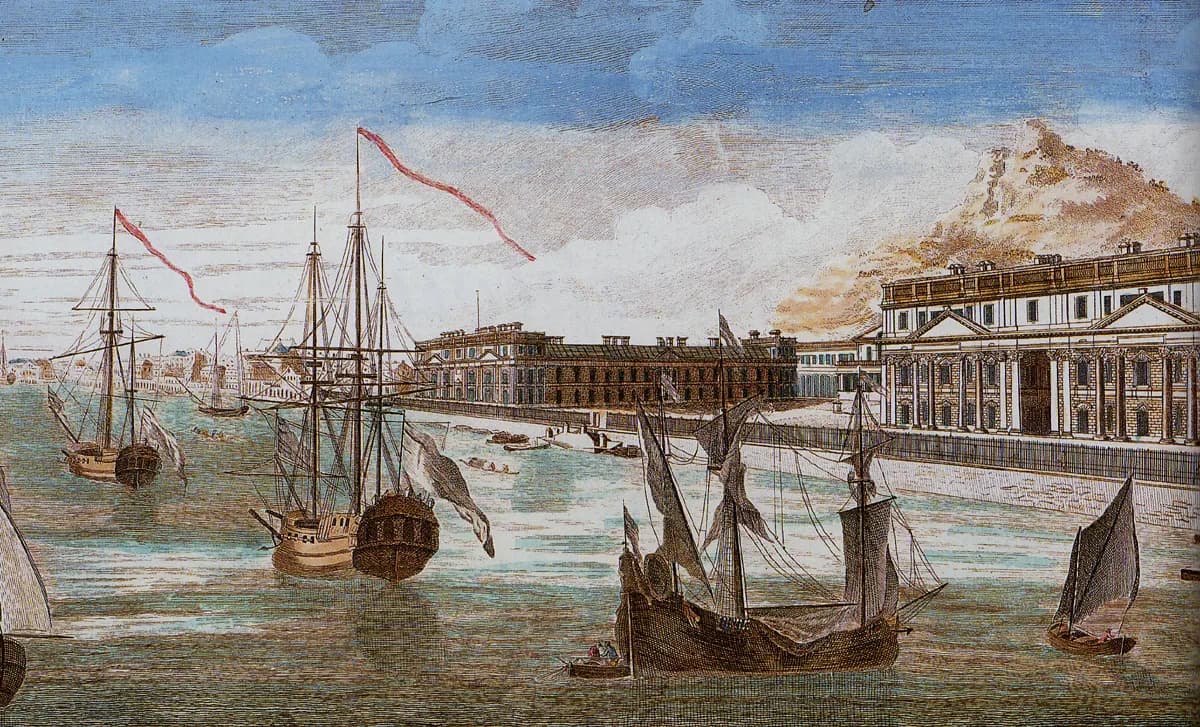
The Europeans Arrive
Five European powers tried to establish themselves on the Coromandel Coast. Only one succeeded in building something that lasted. But it took a century, nine men, and a grid of straight streets to make it work.
The Europeans who changed this coast did not arrive all at once. They came over two centuries, each wave building on the wreckage of the last.
Vasco da Gama and the Portuguese Century
In 1498, Vasco da Gama rounded the Cape of Good Hope and anchored at Calicut. The sea route to India was open, and Portugal moved fast. Within twelve years, Afonso de Albuquerque had captured Goa, establishing the headquarters of the Estado da India that would survive, in one form or another, until 1961. The Portuguese changed everything about the political economy of the Indian Ocean: by controlling the sea lanes, they taxed every vessel that passed.
Their presence on the Coromandel Coast was more modest. They established a factory at Nagapattinam, to the south, and Catholic missionaries moved rapidly through the fishing villages. The legacy of that century survives in unexpected places: the Catholic communities around Pondicherry's older neighbourhoods, with their statues and their feast days, trace their faith directly to Portuguese missionaries of the sixteenth century.
But Pondicherry itself was not a Portuguese possession. The coast here was under the Nayaks of Tanjore, contested by the Golconda Sultanate. The Europeans had not yet arrived in earnest.
The Danish Anomaly
Forty kilometres north of Pondicherry, at a place the Danes called Tranquebar and the Tamils have always called Tharangambadi, meaning "the place where the waves sing," the Danish East India Company established a trading post in 1620. The Nayak of Tanjore granted them the land; they built Fort Dansborg, which still stands today, a compact yellow fortress at the sea's edge.
The Danes brought Lutheran missionaries who produced the first Tamil-language printing press and the first translation of the Bible into Tamil. Their settlement lasted until 1845, when they sold it to the British. It is a footnote in most histories, but it matters: it shows how many powers were working this coast simultaneously, each with its own flag, its own church, its own calculation about what India might offer.
The Dutch and the French
The Dutch East India Company, the VOC, was the dominant European commercial power in Asia through most of the seventeenth century. They established settlements at Pulicat, north of Madras, and at Nagapattinam. They briefly held Pondicherry itself in 1693, taking it from the French after a military engagement, and returned it the following year as a diplomatic concession. They had more pressing concerns elsewhere.
The French had first arrived at Surat in 1668, with the establishment of the Compagnie des Indes Orientales under Louis XIV's minister Colbert. But the settlement at Pondicherry was the work of one man.
François Martin and Nine Men
In 1674, a French merchant named François Martin arrived at the site of Pondicherry with nine companions and a modest amount of capital. He had been working the Coromandel Coast since 1665, learning its languages, its markets, and its political structures. He had watched the Dutch, the British, and the Portuguese operate at close range and formed his own views about what worked.
He obtained a grant of land from the local Mughal governor, Sher Khan Lodi, and began to build. What he built was a grid: a rational, planned settlement divided by a canal into a French quarter to the east and an Indian quarter to the west. The streets ran straight. The warehouses and the governor's residence faced the sea. The canal became the boundary between two worlds that would coexist, uneasily, for three centuries.
Martin governed Pondicherry for thirty-two years, surviving wars, Dutch occupation, and the chronic indifference of Paris. When he died in 1706, still in Pondicherry, he left behind a functioning city of several thousand people and a commercial network that reached across the entire coast. The street named after him in the French Quarter today is one of the quieter ones. It deserves more notice.
The British at Madras
Sixty-five kilometres to the north, the British East India Company had been established at Madras since 1639. Fort St. George, their fortified trading post, had grown into a substantial settlement by the time Martin arrived. The two companies coexisted in uneasy commercial rivalry for decades, occasionally sliding into open conflict when their European wars gave them license.
It was the long competition between French Pondicherry and British Madras that would define the history of the Coromandel Coast for the next century. The Portuguese had tried and left their faith. The Danes had tried and left their printing press. The Dutch had tried and calculated that the profit was elsewhere. Two remained, facing each other down the same narrow strip of coast. The contest between them would be decided not by trade, but by the ambitions of a single extraordinary governor who arrived in Pondicherry in 1742 convinced he could change the rules of the game.

The Pondy App
Take this guide with you
Offline maps, street-level history, restaurant picks, and hotel guides: everything on this site, in your pocket.