
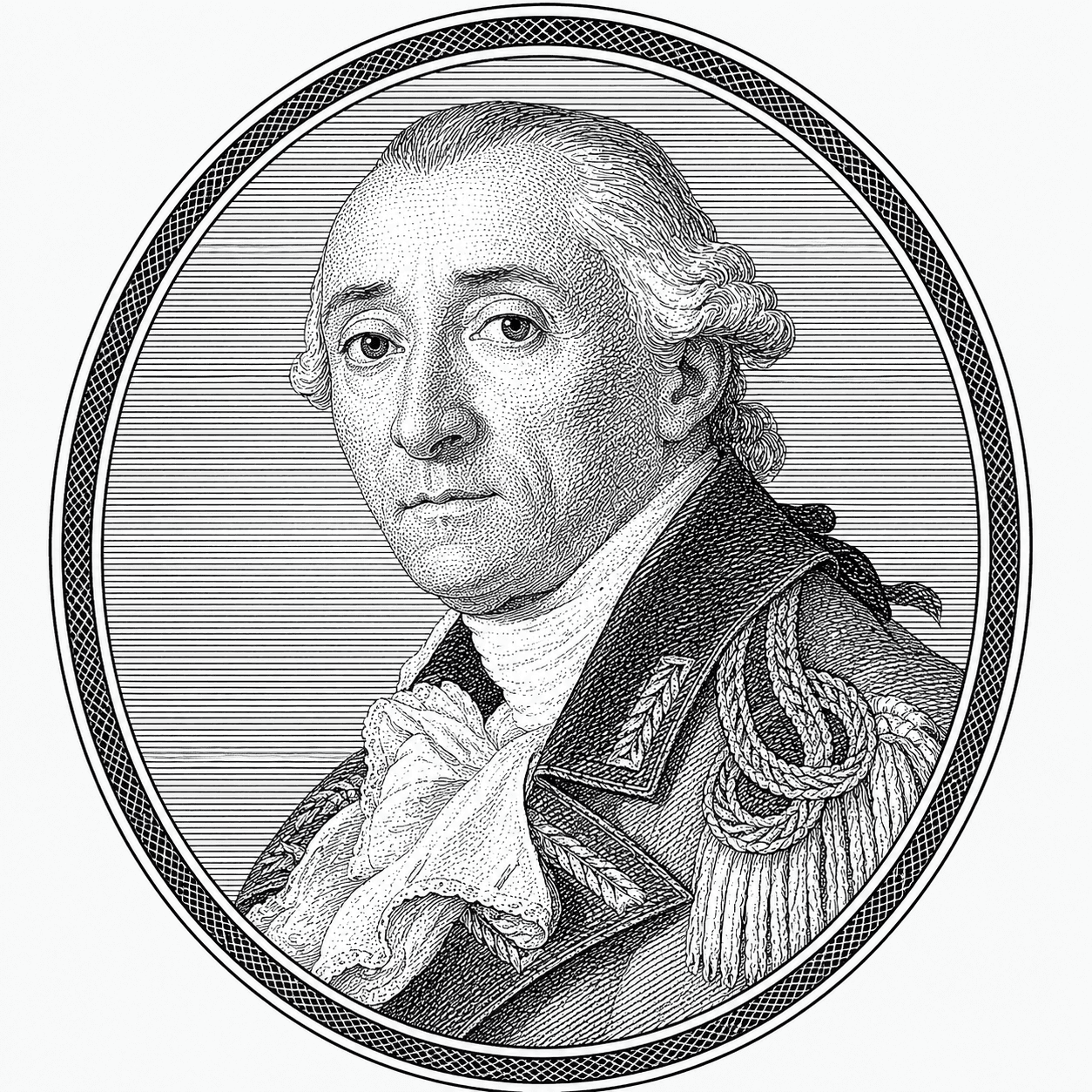
1735–1800
Claude Martin, Pondicherry
Soldier, collector, and founder of the La Martinière schools
He arrived in Pondicherry as a common soldier under Dupleix and Lally. When the city fell in 1761 he switched sides, and died forty years later in Lucknow as a Major-General worth nearly half a million pounds.
FROM PONDICHERRY TO CONSTANTIA
Claude Martin was born in Lyon in 1735, the son of a cooper, and apprenticed to a silk weaver before he enlisted with the French Compagnie des Indes in September 1751, aged sixteen. His mother reportedly told him not to come home until he could arrive in a carriage, a remark that would prove darkly ironic: the French Revolution made any return to France impossible, carriage or not.
Martin served in India under Joseph François Dupleix and General Thomas Arthur Lally during the Carnatic Wars, as French power on the Coromandel Coast was ground down to a handful of coastal outposts. In 1761, Pondicherry fell to the British for the third time, and with it went the French army's pay, discipline, and any realistic future. Three years later, camped on the Karamnassa river after a mutiny among unpaid French and German troops in British service, Martin was approached by fellow Frenchmen planning to desert and join a mercenary commander. He gave an equivocal answer, quietly fell back from the column, and rode for the British camp instead of joining them. His formal British commission is dated 18 April 1764. The choice, made in the ruins of French India, set the course for the rest of his life.
Martin spent the following years as a survey officer under Bengal's Surveyor-General, mapping Awadh, Cooch Behar, and Bengal, and was briefly dismissed from Company service in 1767 over a sedition charge before being reinstated two years later on the strength of his surveying skills. In 1776 he accepted the post of Superintendent of the Arsenal under the Nawab of Awadh at Lucknow, a position that made him useful to the Nawab as a counterweight to the Company and left him, unusually, trusted by both sides at once. He never returned to France, and he never changed his nationality: he died in 1800 a Frenchman who had spent his entire adult life in British and Nawabi service.
At Lucknow, Martin became one of the largest landholders in northern India and assembled one of the great private collections of the age: manuscripts, miniature paintings, coins, and naturalia, catalogued at his death across roughly eighty pages, alongside a personal library of more than four thousand books. He commissioned around 650 paintings of Indian birds from Mughal-trained artists, a collection that sat forgotten at Kew Gardens for two centuries until its rediscovery was called "the biggest discovery" of a major 2020 London exhibition on East India Company painting. His great building project, Constantia, on the banks of the Gomti, combined banquet hall, mansion, fortress, and his own mausoleum in one six-storey structure, designed specifically so the Nawab, who had repeatedly tried to acquire it, could never take it from him while he lived, and would find it a tomb the moment he did.
Martin never married, though he maintained a decades-long relationship with a companion named Boulone, whom he had purchased as a child and who is buried in the grounds of the college he founded. His will, proved only after decades of delay, endowed six schools bearing the name La Martinière, in Lucknow, Calcutta, and his native Lyon, open in principle to children of every race and nationality. They still operate today. A common soldier from Pondicherry's garrison who switched sides when the city fell became, in the end, one of the most improbable philanthropists of colonial India.

The Pondy App
Take this guide with you
Offline maps, street-level history, restaurant picks, and hotel guides: everything on this site, in your pocket.