
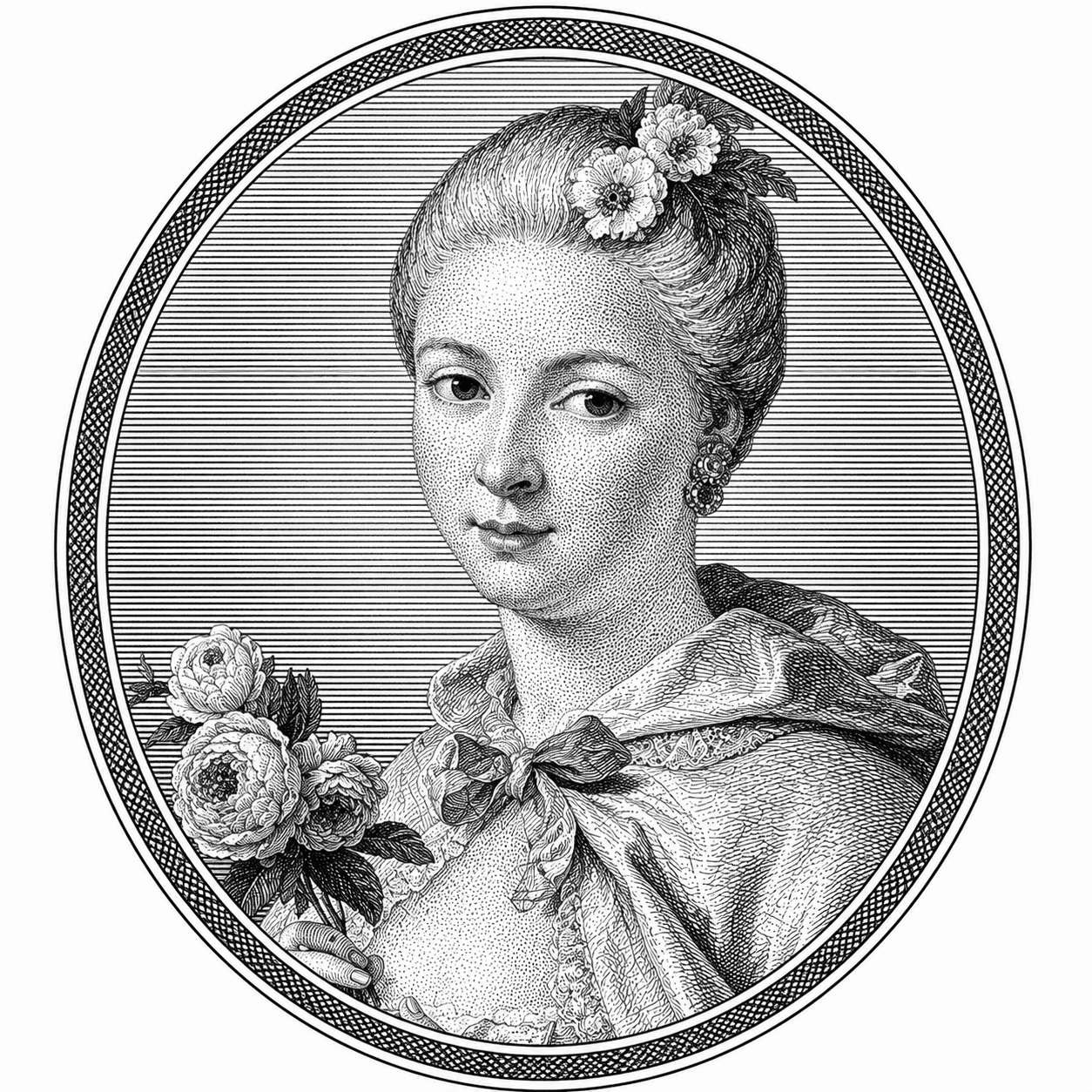
Artist's impression — no portrait of Cuperly survives.
Dates unknown, fl. 1650s–after 1706
Marie Cuperly, Pondicherry
Wife of François Martin, founder of Pondicherry
A Parisian fishmonger's daughter who married in secret, was abandoned for twenty-two years while her husband built French India, and then arrived to share his triumph, his captivity, and his city.
THE FISHWIFE'S DAUGHTER
Marie Cuperly is one of the very few women of French India's founding generation whose name survives at all, and the only one whose life touches every part of Pondicherry's earliest story. She was born in Paris into the world of Les Halles, the daughter of a fishmonger, a milieu entirely removed from the merchants and officers who staffed the Compagnie des Indes. There she met François Martin, the future founder of Pondicherry, then working as a shop assistant in the same district. They fell in love without her mother's knowledge and married in secret.
When the marriage was discovered, both families reacted badly. Marie's mother expelled her and refused to recognise Martin as a son-in-law; Martin's employer dismissed him for the same marriage. The young couple began their life together twice disgraced, with no income and no allies. Marie returned to selling fish at the market to keep the household alive while Martin took whatever ledger work he could find. At least one daughter, Marie-Anne, was born into this poverty.
In the summer of 1664, Martin saw a Compagnie des Indes recruitment notice offering passage and employment in Madagascar and the Indies. He left in March 1665, and according to the traveller Robert Challes, who visited Pondicherry decades later and recorded the story, he left without telling his wife where he was going or how to reach him. Marie Cuperly went more than twenty-two years without news of her husband, raising her children alone on what she earned at the market. The Compagnie is said to have searched the Halles district for six weeks before it could even locate her to confirm Martin's own account of his marriage.
She reached Pondicherry in April 1674 with her daughter Marie-Anne, three months after Martin had re-established the French position there following the fall of San-Thomé. She arrived to a settlement of reed huts and salt pans and watched it become the principal French base in India over the next two decades. When the Dutch besieged and captured Pondicherry in 1693, Martin was taken prisoner to Batavia. Marie Cuperly chose to go with him into captivity rather than remain behind, and the family did not return until the Peace of Ryswick restored the city to France in 1697.
By the time Martin died in December 1706, all three of their daughters had married into the leadership of French India: one to the first Director of Chandernagor, one to the Major responsible for Pondicherry's garrison, one to a senior Company officer. Marie Cuperly outlived her husband. Her own will was discovered alongside his in Pondicherry in 1918, confirming what Challes had reported two centuries earlier, though the date and circumstances of her own death were never recorded. What survives of her is not an official portrait but the shape of an entire life: a fishmonger's daughter who sold fish in Paris while her husband built an empire, and who arrived in India not as an administrator's consort but as a woman who had already survived worse than anything the colony could offer.

The Pondy App
Take this guide with you
Offline maps, street-level history, restaurant picks, and hotel guides: everything on this site, in your pocket.