
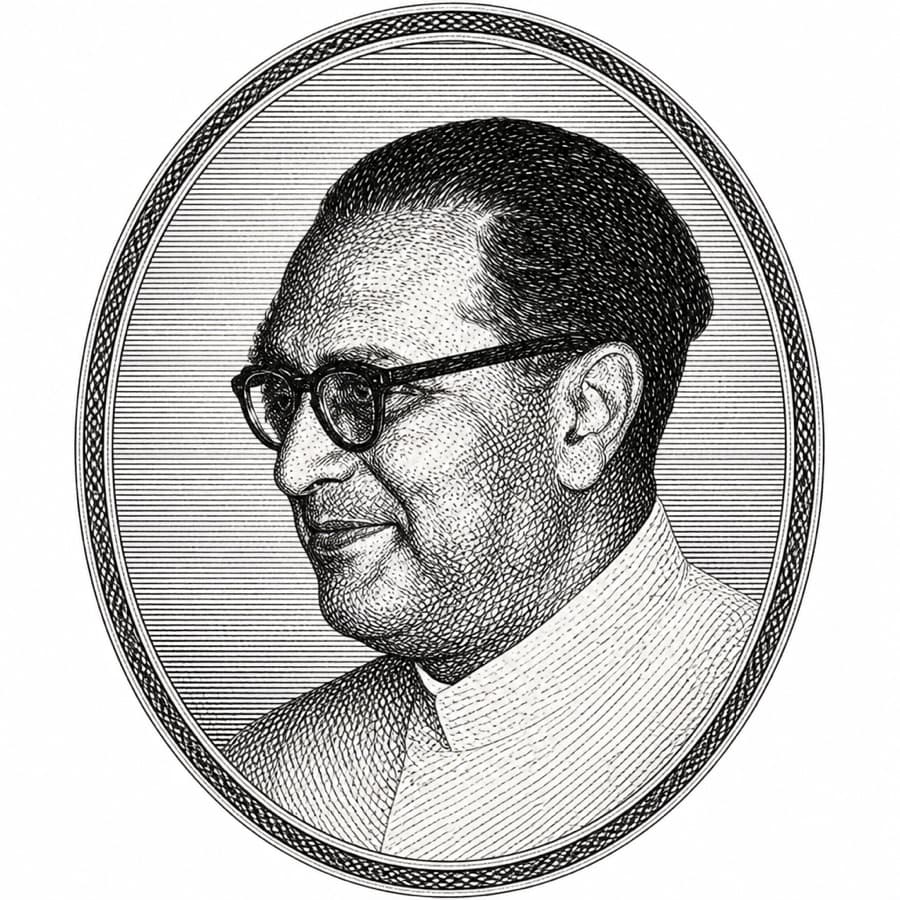
1905–1979
Mirza Rashid Ali Baig, Pondicherry
Inaugural Consul-General of India in French India
The Sandhurst-trained Muslim aristocrat who broke with Jinnah over Partition, chose India, and arrived in Pondicherry in 1947 as the first face of independent India in the French city, at the precise moment everything was about to change.
THE MAN WHO CHOSE INDIA
Mirza Rashid Ali Baig was born in Hyderabad, Sindh, on 25 March 1905, into a family that claimed descent from Timur. His father Sir Mirza Abbas Ali Baig was Chief Minister of Junagadh state. The family was exactly the kind of Muslim aristocracy that had navigated the transition from Mughal to British India across several generations: well-connected, multilingual, comfortable in both worlds. Baig was educated at Clifton College in Bristol and at the Royal Military College, Sandhurst, was commissioned into the British Indian Army in 1924, and resigned his commission in 1930.
After leaving the army he became private secretary and ghostwriter to Muhammad Ali Jinnah, the future founder of Pakistan. For nearly a decade he worked in the closest possible proximity to the defining political figure of Muslim India. The relationship ended in 1940 over the Lahore Resolution, the declaration demanding a separate Muslim state. Baig could not in good conscience help draft or advance it. He broke with Jinnah, and in doing so chose the side he would spend the rest of his life on.
He went on to become Sheriff of Bombay in 1942, joined the Indian Foreign Service, and in 1947 was posted to Pondicherry as the inaugural Consul-General of India in the French and Portuguese Establishments in India, the first diplomatic representative of independent India to French India. His office was at 7 rue des Capucins, the street now known as rue Romain Rolland. He arrived at the precise moment when India's relationship with the French settlements became a live political question: independence had transformed the enclaves from colonial outposts surrounded by British India into something more precarious, surrounded now by a sovereign state with a clear interest in their incorporation.
The symbolic dimensions of the posting were considerable. A Muslim aristocrat of Mughal lineage, educated at Sandhurst, who had been Jinnah's personal secretary and had rejected Pakistan, serving as the face of secular, plural India to a French colonial enclave that was anxiously watching the subcontinent tear itself apart. His brother Mirza Osman Ali Baig, a year older, had made the opposite choice at Partition and became a Pakistani diplomat. The two brothers embodied in personal terms the sundering that Partition imposed on Muslim families of the old colonial service class.
He served in Pondicherry through the critical early phase of the merger movement, from 1947 to 1949, before moving on to Jakarta, Manila, and eventually Tehran, where he served as Indian Ambassador. He died in 1979. His memoir In Different Saddles (1967) covers his military, political, and diplomatic career; The Muslim Dilemma in India (1974) addresses the position of Muslims in independent India, a subject on which, having broken with Jinnah and chosen India, he had singular standing. The Indian consulate he established at rue des Capucins opened the diplomatic process that ended with the transfer of Pondicherry to India in 1954.

The Pondy App
Take this guide with you
Offline maps, street-level history, restaurant picks, and hotel guides: everything on this site, in your pocket.