
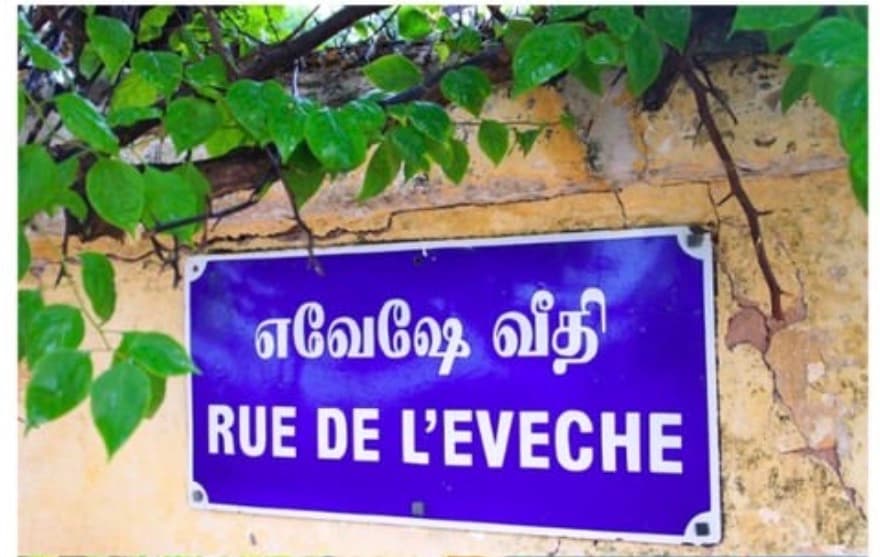
East–West Street
Rue de l'Évêché, White Town, Pondicherry
Also known as: Bishop's Lane
Named after: The Évêché (bishop's palace), seat of the Catholic Diocese of Pondicherry
Welcome to Rue de l'Évêché, one of the smallest streets in the White Town. Évêché means bishop's palace in French. This short lane takes its name from the Catholic bishopric of Pondicherry, whose roots go back to the MEP missionaries who arrived here in the 1670s, almost as early as the French themselves.
The Missions Étrangères de Paris established the Catholic mission in Pondicherry from the early years of the French settlement, arriving in 1674 alongside the first French traders. For three centuries the MEP maintained the Church's presence in French India: building churches, running schools, burying the dead in the cathedral cemetery on Rue Dumas, and in time establishing the episcopal hierarchy that this street commemorates.
In 1776 the MEP took over the Carnatic mission from the departing Jesuits, its superior based here in Pondicherry, though still decades from having a bishop of its own. Pondicherry was not raised to an Apostolic Vicariate until 1836, with Mgr. Bonnand as its first vicar apostolic, and the vicariate was elevated to a full archdiocese in 1886. The évêché, the bishop's palace and administrative seat, gave its name to this lane, which sits between the canal and Rue Victor Simonel in the quieter western edge of the White Town grid.
One villa on the street still carries that history forward. Dating to the 1790s, it later passed to the Goubert family, whose name lives on in Pondicherry's Goubert Market, and today operates as a heritage hotel, Résidence de l'Évêché, on the very lane the bishopric named.
It is a small street. Not every street in a colonial city is named after a battle or a governor. Some are named for the institutions that held the fabric of daily life together: the company, the church, the bishop's house at the end of a quiet lane.
Notable on this street
- Évêché means bishop's palace. The street is named after the seat of the Catholic Diocese of Pondicherry.
- The MEP (Missions Étrangères de Paris) arrived in Pondicherry in 1674, the same year as the first French settlement. The Church and the Company built this city together.
- The MEP took over the mission from the Jesuits in 1776, but Pondicherry only became an Apostolic Vicariate in 1836. The vicariate was elevated to an archdiocese in 1886.
- A 1790s villa on the street later belonged to the Goubert family, namesake of Pondicherry's Goubert Market. It's now a heritage hotel, Résidence de l'Évêché.
- One of the smallest streets in the White Town, tucked between the canal and Rue Victor Simonel. The name is bigger than the street.

The Pondy App
Take this guide with you
Offline maps, street-level history, restaurant picks, and hotel guides: everything on this site, in your pocket.