
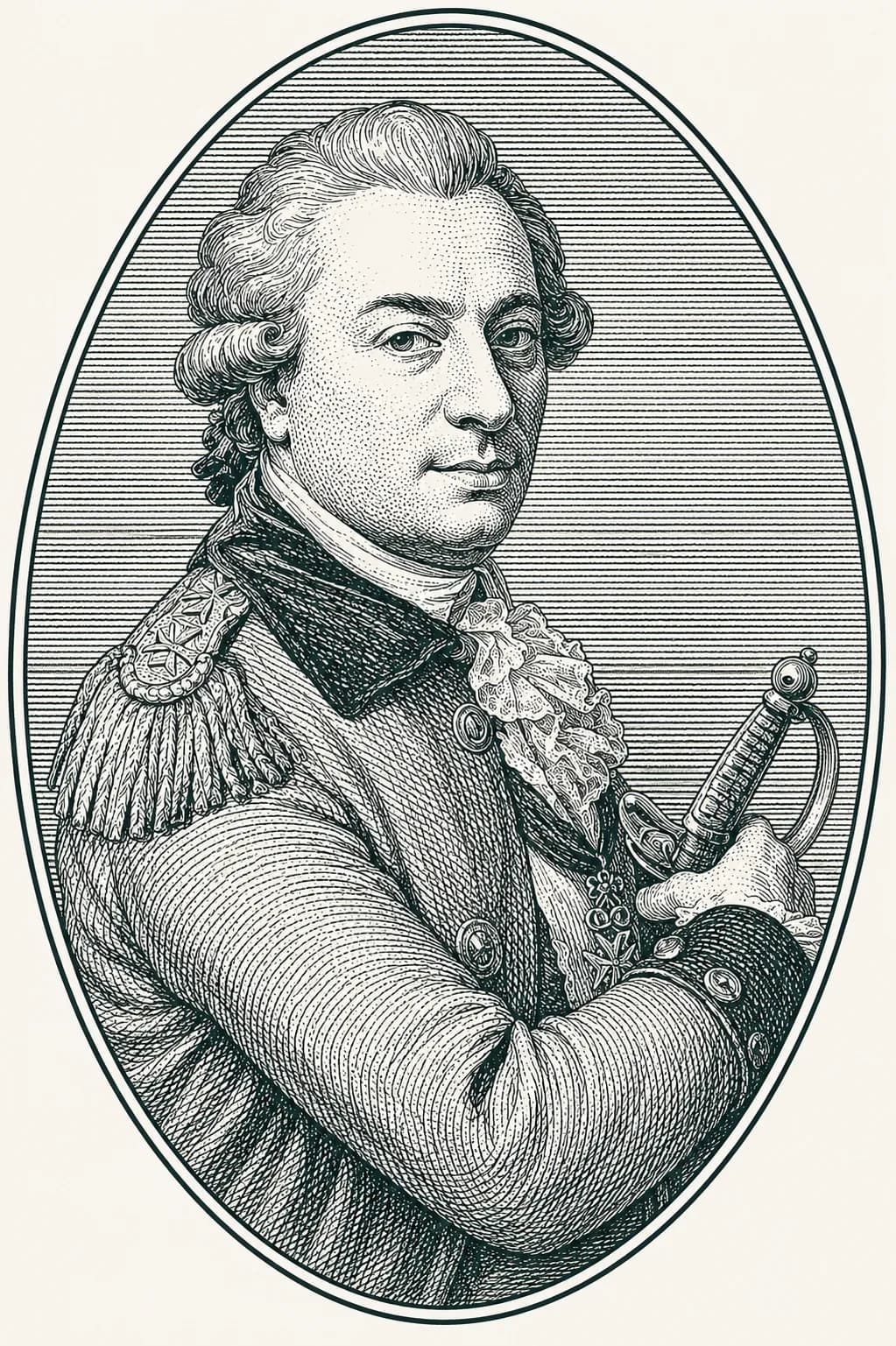
1729–1788
Pierre André de Suffren, Pondicherry
Vice-Admiral, French Navy
The greatest French naval commander of the eighteenth century, who fought five battles on the Coromandel Coast in 1782 and 1783 and came closer than anyone to reversing Britain's ascendancy in India.
THE ADMIRAL OF THE INDIAN OCEAN
Pierre André de Suffren de Saint-Tropez was born in 1729 in Provence into a naval family and entered the French navy early. He fought at Lagos in 1759, was briefly captured by the British, and spent the following decades in the Mediterranean and Atlantic accumulating experience across every form of naval warfare available to an eighteenth-century officer. By the time he was given the Indian Ocean command in 1781, he was fifty-two, physically formidable, temperamentally aggressive, and in possession of a tactical imagination that set him apart from every other French naval commander of his generation.
His campaign on the Coromandel Coast between February 1782 and June 1783 produced five major naval engagements against the British Admiral Edward Hughes: Sadras, Providien, Negapatam, Trincomalee, and Cuddalore. Each was fought with forces Suffren considered inadequate, against subordinate captains he frequently accused of timidity approaching treachery. He improvised repairs at Trincomalee while the British resupplied from Indian ports; he sustained his ships past what any logistical calculation should have permitted. None of the five battles was strategically decisive, but together they prevented Britain from consolidating naval control of the Coromandel Coast and kept open, for nearly two years, the possibility of a Franco-Mysorean combination that might have reversed the post-1763 settlement.
He coordinated directly with Hyder Ali, and then, after Hyder Ali's death in December 1782, with Tipu Sultan, who was fighting Britain from the land side in the Second Anglo-Mysore War. Their cooperation was the most credible Franco-Indian military combination since the Dupleix era: a French admiral controlling the sea while Mysore threatened British positions from the interior.
The peace of 1783 ended his campaign before a decision could be reached. He returned to France celebrated as a hero, was promoted Vice-Admiral, and died in Paris in December 1788, possibly in a duel arising from one of his many personal quarrels. His campaign represents the last moment at which France might realistically have recovered its naval position in the Indian Ocean. A street in the White Town bears his name.

The Pondy App
Take this guide with you
Offline maps, street-level history, restaurant picks, and hotel guides: everything on this site, in your pocket.