
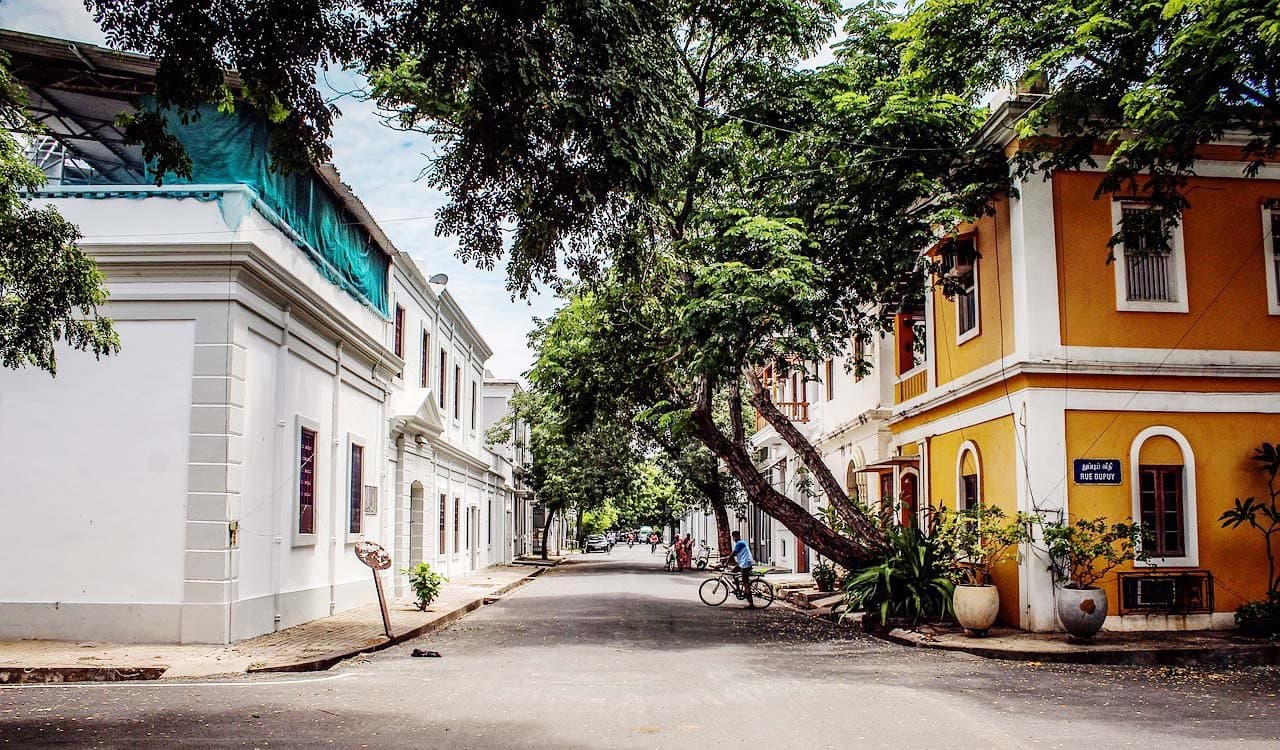
East–West Street
Chanda Sahib Street, White Town, Pondicherry
Also known as: Rue Chanda Sahib
Named after: Chanda Sahib (died 1752), Nawab of the Carnatic and principal Indian ally of Dupleix in the Carnatic Wars
Welcome to Chanda Sahib Street, named after the man Dupleix chose to be Nawab of the Carnatic. He was proclaimed Nawab at Ambur in 1749, held the position for three years against British-backed resistance, and was beheaded on 12 June 1752 on the same afternoon the last French field force in the Carnatic surrendered at Srirangam. Two events, one afternoon, the end of French dominance in South India.
Chanda Sahib, born Husayn Dost Khan, was son-in-law to the Nawab of the Carnatic and had served as his Dewan and military commander. He spent seven years as a Maratha prisoner after the invasion of 1740, returning in 1748 to find Dupleix actively searching for a credible Indian claimant with Mughal legitimacy and deep Carnatic connections. The timing was exact. At the Battle of Ambur on 3 August 1749, a combined French and allied force killed the incumbent Nawab and Chanda Sahib was proclaimed his successor. He rewarded the French generously: territory, military command, and formal recognition of French sovereignty over their Pondicherry settlements.
The British-backed rival, Muhammad Ali, retreated to the rock fortress of Trichinopoly and held. Robert Clive's seizure of Arcot in 1751 diverted Chanda Sahib's forces from the critical siege, and the campaigns of 1751 and 1752 went steadily against the French alliance. On 12 June 1752, on the island of Srirangam, the French commander Law de Lauriston was encircled by Clive and forced to surrender his entire force. On the same afternoon, Chanda Sahib was captured by soldiers of the Tanjore army and beheaded. Dupleix's protectorate over the Carnatic collapsed in a single afternoon.
His street is in the quarter between the old French and Tamil cities, fitting for a man who lived at the intersection of French strategic calculation and Indian political legitimacy. Without a credible Indian claimant, Dupleix's strategy could not have worked. Chanda Sahib was not merely an instrument: he was the essential Indian face of an empire France was trying to build through the choices of Indian rulers.
Notable on this street
- Beheaded 12 June 1752, the same afternoon Law de Lauriston surrendered at Srirangam. Two events, one afternoon, the definitive end of French dominance in the Carnatic.
- He spent seven years as a Maratha prisoner before returning to ally with Dupleix. His release coincided exactly with Dupleix's moment of maximum strategic need.
- At Ambur, 3 August 1749: the incumbent Nawab was killed and Chanda Sahib proclaimed. The French detachment's firepower and discipline were decisive. It was convincing proof of what European-trained troops could do.
- Muhammad Ali, the British-backed rival, held Trichinopoly throughout. The siege of that fortress was the strategic centre of the Carnatic Wars. It never fell.

The Pondy App
Take this guide with you
Offline maps, street-level history, restaurant picks, and hotel guides: everything on this site, in your pocket.